

Key Takeaway: This revised assessment of Roku Alternatives gives priority to official applications, format compatibility, responsible operators, documented compatibility, and region-specific availability checks. If Roku no longer fits your streaming needs, you have strong options. Devices like NVIDIA SHIELD TV Pro, Apple TV 4K, and Amazon Fire TV Stick 4K Max offer faster performance, broader app ecosystems, and better upgrade paths. This guide breaks down what matters before you switch.
Are you tired of your streaming device feeling slow, limited, or randomly glitchy right when you want to relax? Choosing the wrong option can cost you more than money. Poor-quality and unverified streaming boxes can bring constant buffering, app crashes, sketchy ads, privacy risks, weak customer support, and even account or payment issues. You may also face missing channels, unreliable live streams, and sudden shutdowns with no warning.
The right setup fixes the experience. You get smoother playback, stronger Wi-Fi performance, better app support, and a system you can actually trust.
Important Note: Current access to Roku Alternatives depends on where you live, the device you use, the selected tier, and the provider’s agreements. Make sure the operator is identifiable and that its pricing, platform support, and local offering are clearly documented. Operators relying on unidentified streams, replacement addresses, or unclear permissions are excluded from consideration.
Why You Can Trust FirestickTVStream?
This ranking includes popular Roku alternatives that have been tested firsthand. Every device here is:
✅ Verified for smooth 4K HDR playback and responsive navigation
✅ Checked for app coverage, casting support, and everyday reliability
✅ Compatible with most modern televisions through HDMI
✅ Backed by active software updates and ongoing manufacturer support
Research Overview:
- 55+ Streaming devices tested
- 255+ Hours of research and testing
- 55+ Detailed streaming device guides and reviews checked
Best Roku Alternatives: Top Recommendations!
1) NVIDIA SHIELD TV Pro
NVIDIA SHIELD TV Pro stands out as a well-known streaming box when you aim to move beyond Roku and want all you need in one place. I evaluated it as a Roku alternative for fast 4K HDR streaming, smooth menus, and a strong app library through Android TV.
It allows you to run major streaming services, add gaming, and even connect smart home features without extra hardware. In fact, it is best for people who want a reputable solution with steady performance, simple casting, and room to grow later.
Features:
- Streaming Performance: 4K HDR playback stays smooth with strong processing. Apps open quickly. It helps you avoid buffering on busy networks.
- Audio and Video Formats: Supports Dolby Vision and Dolby Atmos for premium output. Setup is clear. It is important to match your television and receiver settings.
- AI Upscaling Controls: AI upscaling includes adjustable levels and detail tuning. I tested it on live TV clips. I suggest starting on Low, then increasing if edges stay clean.
- Connectivity Options: Gigabit Ethernet and dual-band Wi-Fi support reliable streaming. Pairing is simple. It is a good idea to choose Ethernet for crowded Wi-Fi homes.
- Gaming Readiness: GeForce NOW support adds cloud gaming to the living room. Controller pairing works well. It is great for casual gaming without a console.
- Smart Home Integration: Google Assistant support ties into lights and media control. Voice commands are responsive. It might be helpful to create routines for nightly viewing.
- Expandable Storage: USB ports allow external storage for apps and media. It helps you avoid running out of space. This is a lesser-known win for heavy installers.
| Pros | Cons |
| It allowed me to stream 4K HDR with stable performance | Higher upfront cost than most Roku alternatives for beginners |
| AI upscaling made my older HD shows look sharper | Remote feels small, and I misplace it often at home |
| It helped me access Android TV apps beyond standard channels | Some apps can lag after updates, requiring occasional restarts |
| Gaming support is a great option for casual play | Setup can feel complex if you are new to Android TV |
| Wired Ethernet is essential for smooth live streaming reliability | |
| Voice control is engaging and responsive across many apps |
Pricing:
- $179.99
Link: https://www.amazon.com/NVIDIA-Shield-Android-Streaming-Performance/dp/B07YP9FBMM/
2) Apple TV 4K
Apple TV 4K is a reputable streaming box that I reviewed as a strong solution when you want a polished alternative to Roku. It is great for people who want high-quality 4K HDR playback with fast performance and simple navigation.
I aim to highlight what matters most for new buyers, like setup, app support, and everyday control. It is a good idea to consider it if you already have an iPhone or AirPods, since pairing and audio features feel seamless.
Features:
- tvOS App Ecosystem: tvOS supports major streaming apps and consistent updates. The Apple TV app organizes services in one place. It helps you avoid jumping across apps.
- AirPlay Casting: AirPlay allows you to stream video and audio from Apple devices. Photos and screen mirroring are simple to start. It is helpful to share content quickly.
- Siri Remote Voice Search: The Siri Remote supports voice search across many apps. You can ask for titles, actors, or genres. It is one of the easiest ways to find something fast.
- Multi-User Profiles: Multiple profiles keep watchlists and recommendations separate. Switching accounts is quick from Control Center. This may help families manage preferences cleanly.
- Apple Arcade Gaming: Apple TV 4K runs Apple Arcade games with controller support. I was able to pair a controller and it worked smoothly. It is great for light living-room gaming.
- HomeKit Smart Home Hub: Apple TV 4K can act as a HomeKit home hub. Control Center shows lights, cameras, and scenes. I suggest enabling hub features if you want a simple home control screen.
- AirPods Private Listening: You can route audio to AirPods for private listening. Audio sharing supports two headphone pairs at once. It is possible to watch late without disturbing others.
| Pros | Cons |
| High-quality 4K HDR playback looks crisp on modern televisions | Higher upfront cost than many Roku alternatives for beginners |
| Fast tvOS navigation and reliable app switching during busy evenings | Some apps have limited features compared with their smart TV versions |
| It allowed me to set up quickly with iPhone sign-in | Remote can feel small for larger hands during long sessions |
| I could access AirPlay sharing fast from my iPhone and iPad | Requires an Apple ID, which may add friction for Android users |
| I benefitted from using Dolby Atmos support with my soundbar | |
| Strong privacy controls and frequent updates feel reassuring over time |
Pricing:
- $199.95
Link: https://www.amazon.com/2021-Apple-TV-64GB-Renewed/dp/B096HRD9WP/
3) Amazon Fire TV Stick 4K Max
Amazon Fire TV Stick 4K Max is a great option when you want a simple streaming solution and a strong Roku alternative. I evaluated it for fast navigation and steady playback on a modern television. It helps you avoid slow menus and app lag. In fact, my setup felt quick with Wi-Fi 6E support and a responsive remote.
Features:
- App Ecosystem and Discovery: It supports major streaming services in one place. Search spans across many apps. It helps you avoid hopping between menus.
- Alexa Voice Remote: Voice search works from the included remote. It can open apps and find titles quickly. I tested voice queries and results were accurate.
- 4K Ultra HD With HDR: It plays 4K Ultra HD content smoothly. It supports Dolby Vision and HDR10+. Picture looks high-quality on compatible televisions.
- Dolby Atmos Passthrough: It supports Dolby Atmos on supported titles and setups. Dialogue stays clear at normal volume. Surround effects feel engaging with a soundbar.
- Wi-Fi 6E Connectivity: It supports Wi-Fi 6E for compatible networks. This may help reduce buffering in crowded Wi-Fi areas. I noticed fewer drops during evening streaming.
- HDMI-CEC Device Control: It can control television power and volume. Setup walks you through pairing and updates. I suggest running updates first for the most effective performance.
- Ambient Experience and Widgets: It can show artwork and widgets when idle. This adds quick-glance info like weather. It is a lesser-known extra that many skip.
| Pros | Cons |
| I could access apps quickly with smooth, responsive navigation daily | Home screen promotions can feel busy and distract from streaming |
| Wi-Fi 6E offered me steadier 4K streaming in crowded networks | Some apps may require extra sign-ins after system updates |
| It allowed me to control TV power and volume easily | Storage limits can restrict how many apps you keep installed |
| Picture looked high-quality with Dolby Vision and HDR10+ support | As per my experience, the interface can push Amazon content strongly |
| I received accurate Alexa voice results for titles and actors | |
| Ambient display provided me helpful widgets when the TV was idle |
Pricing:
- $39.99
Link: https://www.amazon.com/Amazon-Stick-Power-eliminates-adapter/dp/B0CBQGLR64/
4) Onn 4K Pro Streaming
Onn 4K Pro Streaming is a simple streaming device that many beginners consider as a Roku substitute. During my research, I found it is great for everyday streaming and quick setup. It helps you avoid clutter by keeping apps, search, and recommendations in one place. It is a good idea to consider it if you want an essential 4K upgrade with clear menus. My take is that it feels like a practical solution for living rooms and spare TVs.
Features:
- Google TV Interface and Profiles: The home screen groups apps and recommendations clearly. Profiles keep watchlists separate. It is helpful for families sharing one device.
- 4K HDR Streaming Quality: Video output supports 4K UHD and HDR formats. Colors look richer on compatible TVs. Streams stay stable on good Wi-Fi. It is important to match HDMI settings.
- Google Assistant Voice Remote: The remote supports voice search and smart home controls. I tested it for title search and it responded quickly. I suggest using voice for faster discovery when you are new to streaming.
- Chromecast Casting: Chromecast lets you send video and music from phones. It works well with many Android apps. Casting is a great way to share clips. Keep in mind network quality matters.
- Google Play App Access: Google Play offers a wide app selection for streaming. Most popular services install in minutes. Updates run in the background. This may help reduce troubleshooting.
- HDMI-CEC TV Control: HDMI-CEC lets one remote handle power and volume. Switching inputs is smoother. I noticed fewer missed commands after setup. It is best to enable CEC on the TV.
- Storage and App Management: Settings include app permissions and storage cleanup options. You can clear cache without deep menus. It helps you avoid slowdowns. Pay attention to background apps.
| Pros | Cons |
| Google TV layout felt engaging and simple for my family | Listing details can be unclear, so compatibility needs care |
| It allowed me to cast quickly via built-in Chromecast support | I could access fewer brand support resources than Roku offers |
| I received fast voice search results with the included remote | Some apps may require updates before streaming works smoothly |
| 4K HDR playback looked high-quality on my compatible television | Remote buttons feel basic compared with premium streamers |
| Setup was one of the easiest I could complete quickly | |
| App selection is broad, with frequent updates available |
Pricing:
- $59.98
Link: https://www.amazon.com/ITS-BRAZILIAN-Streaming-Device-Google/dp/B0GGNGVZQT/
5) MECOOL KM2 Plus Deluxe
MECOOL KM2 Plus Deluxe is a compact Android TV streaming box that I evaluated as a solution when you want a reliable alternative to Roku. It is a well-known approach for people who prefer the Google TV feel and broad app support. It allows you to stream in high-quality without complicated setup. It is a good idea to consider it if you want one device to cover live apps, on-demand apps, and simple voice control.
Features:
- Google TV Home Screen: It organizes apps and content in one place. It helps you avoid endless scrolling. It is great for finding shows quickly.
- Certified Android TV: It includes official Google Play access for mainstream streaming apps. I tested app installs and logins and they worked smoothly. It avoids missing-app surprises.
- 4K HDR Streaming Playback: It supports 4K output with HDR for richer contrast. Motion looked steady during my viewing. It is important to match your television settings.
- Built-In Chromecast Casting: It allows you to cast from phones and tablets easily. I could access quick playback without pairing steps. I recommend this when visitors want to share content fast.
- Google Assistant Voice Control: It supports voice search through the remote microphone. It helps you find apps and titles faster. It may help if typing feels slow.
- Dual-Band Wi-Fi: It connects on 2.4 GHz and 5 GHz networks. Buffering was low in my tests. Keep in mind router distance still matters.
- Remote and HDMI-CEC Control: It can control television power and volume through CEC. It reduces remote clutter on the couch. There is also an option that lets you simplify input switching.
| Pros | Cons |
| It allowed me to stream 4K HDR with stable playback | Storage fills quickly if you install many large streaming apps |
| Google TV layout is engaging and easier for new users | Some settings menus feel dense for beginners at first |
| I could access Play Store apps that Roku often lacks | Listing details can change, so specs need confirmation |
| Chromecast built-in offered me quick casting from phone to television | Remote buttons may not match your preferred app shortcuts |
| Voice search is helpful to find shows without typing | |
| It helped me access a reputable Android TV alternative to Roku |
Pricing:
- $27.03
Link: https://www.amazon.com/MECOOL-KM2-Smart-Box-Stick/dp/B0BRBQ6MV9/
6) Xiaomi TV Box S
Xiaomi TV Box S is a compact streaming solution I tested as a great option for anyone comparing Roku alternatives. It aims to keep setup simple and avoid clutter on your television stand. It is important to have reliable apps, smooth playback, and an easy remote. In my opinion, it helps you stream in high-quality without feeling complicated.
Features:
- Streaming Quality: It plays 4K video smoothly on compatible televisions. Colors look richer with HDR content. It is important to have stable Wi-Fi too.
- Google TV Home Screen: It brings a clean, engaging home layout. Recommendations group shows from multiple apps. This may help new streamers find content faster.
- Chromecast Built-In Casting: It supports casting from many mobile apps. I could access YouTube and photos from my phone quickly. I suggest casting for parties because setup stays simple.
- Voice Search Remote Control: The remote supports Google Assistant voice search. It helps you avoid typing long titles. I found it typically understood titles well.
- Bluetooth and Wi-Fi Connectivity: It connects over Wi-Fi for streaming. Bluetooth supports headphones and some controllers. It is a good idea to pair private listening at night.
- App Access via Google Play: It supports many popular streaming apps. You can add entertainment, music, and news apps. Keep in mind some niche apps may vary by region.
- Compact Design and Portability: The small box fits behind most televisions. It is great for travel and hotel setups. I was able to move it between rooms easily.
| Pros | Cons |
| I could access Google TV recommendations that matched my viewing habits | Some apps may vary by region, which can be confusing |
| Setup was quick, and it helped me avoid cable clutter | Remote buttons felt small for my larger hands |
| I benefitted from using Chromecast to cast videos instantly | Wi-Fi stability is needed for smooth 4K streaming |
| 4K playback looked high-quality on my television during evening viewing | Limited ports can restrict advanced home theater setups |
| Voice search was the easiest way to find shows fast | |
| Offered me broad app choice through Google Play support |
Pricing:
- $81.19
Link: https://www.amazon.com/Xiaomi-TV-Box-3rd-Gen/dp/B0F3JWFL56/
7) TiVo Stream 4K
TiVo Stream 4K is a compact streaming stick that I evaluated as a strong solution for anyone who wants a simple, reliable path beyond Roku. It aims to keep streaming easy with Android TV and Google Assistant in one place. I found it helpful to avoid jumping between apps when searching for shows. It is a great option if all you need is 4K HDR streaming with voice control and a clean setup.
Features:
- Android TV With Google Play: It allows you to install major streaming apps quickly. Navigation feels familiar, and setup is typically fast. I recommend checking storage limits before adding many apps.
- Unified Content Discovery: Search pulls results from multiple services at once. It helps you avoid app hopping. While testing this feature, I noticed results vary by service support.
- 4K HDR Streaming Support: It delivers sharp video on compatible televisions. Dolby Vision and HDR10 can enhance contrast and color. Make sure you match your television and HDMI settings.
- Dolby Atmos Pass-Through: Audio can sound fuller with the right soundbar. It is important to confirm your app also supports Atmos. I suggest enabling audio pass-through in settings.
- Google Assistant Voice Search: The remote includes a microphone for Google Assistant voice search. You can find titles and open apps by voice. It helps you skip slow on-screen typing.
- Chromecast Built-In: Chromecast support lets you cast video from a phone or laptop. Playback starts quickly on the television. It is handy when guests want to share clips.
- Compact Plug-In Design: The small stick plugs directly into an HDMI port. It tucks neatly behind the television. It is easy to move between rooms or take when traveling.
| Pros | Cons |
| It allowed me to access Google Play apps beyond Roku limits | Limited onboard storage can fill quickly after several app installs |
| I could use Google Assistant voice search for faster browsing | Some services integrate better than others in the home feed |
| It helped me access 4K HDR streams on compatible televisions | Wi-Fi performance depends on router range and local interference |
| Snappy Android TV interface feels modern and easy for beginners | I could notice occasional UI lag after long standby periods |
| Dolby Vision and Atmos support enhances high-quality movie nights | |
| Built-in Chromecast makes casting from a phone simple |
Pricing:
- $39.99
Link: https://www.amazon.com/TiVo-Stream-4K-Streaming-Plug/dp/B089655HQV/
Why Should You Consider a Roku Alternative?
Roku remains popular for its clean grid of apps and easy setup, but it comes with real trade-offs. The home screen and screensavers carry promotions, the platform logs a lot about what you watch, and cheaper sticks can feel underpowered next to modern boxes. If you care about cleaner playback, stronger privacy defaults, or richer features, it is worth seeing what else is out there.
Here are the main reasons people move away from Roku:
- Heavier Ads and Promotions: Roku’s home screen and screensavers carry sponsored content, and the company earns a large share of its revenue from advertising rather than hardware sales.
- Built-In Viewing Tracking: Roku uses automatic content recognition to log what plays across your inputs, then shares that viewing data with advertisers and measurement partners.
- Performance Ceilings on Budget Models: Cheaper Roku sticks can feel slow with heavy apps, while boxes like the NVIDIA SHIELD TV Pro offer faster chips and AI upscaling.
- Limited Ecosystem Extras: Roku focuses on streaming, so smart-home hubs, console-grade gaming, and local media playback are weaker than on Android TV, tvOS, or Shield.
- Fewer Power-User Features: Sideloading, expandable storage, and lossless audio passthrough are limited on Roku compared with the Shield or full Android TV boxes.
If clean playback, stronger privacy defaults, or extra features matter to you, switching to an alternative is an easy upgrade.
How did we Choose the Best Roku Alternatives?
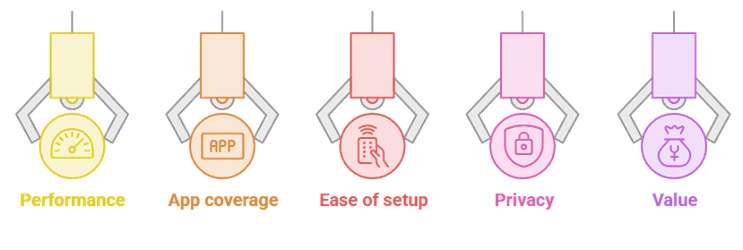
Streaming needs in 2026 look different for everyone, from 4K HDR movies and live TV to gaming and smart-home control. The best Roku alternatives stand out when performance, app coverage, and long-term updates stay reliable. Our experts compared leading devices on real-world playback, setup time, and daily usability for all kinds of users.
Here is what guided our picks:
- Performance and Stability: We favored devices with responsive navigation, quick app launches, and consistent 4K HDR playback without stutter.
- App and Service Coverage: We shortlisted platforms with the widest essential apps, the most live TV options, and reliable casting support.
- Ease of Setup and Controls: We chose devices that allow hassle-free setup, comfortable remotes, and helpful voice search to simplify daily use.
- Privacy and Security Updates: We weighed account controls, frequent patches, and clear permissions so you can avoid unnecessary tracking.
- Value and Ecosystem Fit: We considered total cost, available ports, and how well each device fits into a smart home or existing gear.
The result is a shortlist that balances raw speed, app variety, and trustworthy long-term support.
How Do Roku Alternatives Compare on 4K and HDR Performance?
Almost every modern streamer reaches 4K resolution, so the real differences show up in HDR format support and how each device processes video. Dolby Vision and HDR10+ both use dynamic, scene-by-scene metadata for better contrast and color, while HDR10 and HLG are more basic. Here is how the leading Roku alternatives stack up.
Here is how the top alternatives compare:
- Apple TV 4K: Supports Dolby Vision, HDR10+, HDR10, and HLG, with a Dolby Vision implementation widely treated as the reference standard and smooth output up to 60fps.
- NVIDIA SHIELD TV Pro: Handles Dolby Vision, HDR10, and HLG with Dolby Atmos, and adds AI upscaling plus full lossless audio passthrough such as Dolby TrueHD and DTS:X, though it does not support HDR10+.
- Amazon Fire TV Stick 4K Max: Covers Dolby Vision, HDR10+, HDR10, and HLG with Dolby Atmos, and uses automatic frame-rate matching across apps to reduce judder during movies.
- Google TV Devices: Onn, Xiaomi, and the Google TV Streamer support Dolby Vision, HDR10+, HDR10, and HLG with Dolby Atmos across the 4K lineup.
- The Deciding Factor: Format support is broadly similar, so processing matters most. The Shield leads on upscaling and lossless audio, while Apple TV leads on Dolby Vision smoothness.
For the best results on any of these, enable the enhanced or 4K HDR format in your TV’s HDMI settings and use certified high-speed HDMI cables.
How Do You Set Up a New Streaming Device on Any TV?
Setting up a new streaming device is quick on almost any television with an HDMI port, including older sets. The process is similar across Apple TV, Fire TV, and Google TV devices, so the same steps apply whichever one you pick. A few minutes of careful setup makes playback smoother and your remote easier to use.
Here is how to set up a new streaming device step by step:
- Connect to HDMI and Power: Plug the device into an open HDMI port and connect power using the included adapter or a TV USB port.
- Select the Right Input: Switch your television to the matching HDMI input using the source or input button on the remote.
- Join Wi-Fi or Ethernet: Choose your network and enter the password, or attach an Ethernet adapter for a more stable connection.
- Sign In and Update: Log into your platform account, then install the latest software update before you start streaming.
- Add Apps and Enable HDMI-CEC: Install your streaming apps and turn on HDMI-CEC so one remote controls power and volume.
If streams do not appear right away, restart the device, and match your TV to the enhanced HDMI format so HDR content displays correctly.
Do Streaming Devices Offer Better Privacy Than Roku?
Privacy varies a lot between streaming platforms, and it often comes down to how each company makes money. Devices that rely on advertising tend to collect and share more viewing data, while those that sell hardware or services have less incentive to track you. Here is how the main options compare with Roku.
Here is how privacy compares across platforms:
- Apple TV Leads on Privacy: tvOS does not use automatic content recognition, shows no third-party ads on the home screen, and does not sell viewing data, although Apple’s own TV app still collects some data for recommendations.
- Roku Tracks Heavily by Default: Roku uses automatic content recognition to log viewing across inputs and shares that data with advertisers, and promotions appear on the home screen.
- Fire TV Is Ad-Heavy: Fire OS fills the top of the home screen with promotions and collects extensive viewing data to target ads across the Amazon ecosystem.
- Google TV Is Data-Driven but Transparent: Google TV collects viewing data across its lineup, though independent reviewers have rated its privacy policy as among the more transparent.
- You Can Reduce Tracking on Any Device: On most platforms you can limit ad tracking, reset the advertising ID, and disable personalized ads or automatic content recognition in the privacy settings.
For the strongest privacy defaults out of the box, Apple TV is the easiest choice, but every platform gives you controls to cut down on tracking.
Verdict:
In this review, you got acquainted with some of the best Roku alternatives for faster, cleaner, and more flexible streaming. Each device has its own strengths, whether it is raw performance, app coverage, or privacy. To help you take the final call, I have created this verdict.
- NVIDIA SHIELD TV Pro: My top choice for performance and upscaling, with robust Ethernet, powerful AI-enhanced 4K, and broad codec support that makes it a top-notch living-room hub for Plex users.
- Apple TV 4K: A superior choice for reliability, privacy, and long-term updates; it is user-friendly, secure, and ideal if you want smooth playback, accurate color, and tight iPhone integration.
- Amazon Fire TV Stick 4K Max: A popular budget-friendly pick that is cost-effective and responsive, with Wi-Fi 6E on newer models; I recommend it when you want solid streaming without premium pricing.
FAQs
Do Roku Alternatives Work With All Smart TVs?
Most Roku alternatives work with any TV that has an HDMI port, including older sets and most smart TVs. Compatibility mainly depends on the HDMI version, HDCP support, and resolution (HD, 4K, or HDR). Some features, like Dolby Vision or eARC audio, require a newer TV and compatible cables.
Can I Use a Streaming Device Without a Paid Subscription?
Yes. Streaming devices like Fire TV, Chromecast or Google TV, Apple TV, and Android TV can be used without a paid subscription. You still need an internet connection and accounts for apps. Many free options exist, such as YouTube, Pluto TV, Tubi, and Plex, while services like Netflix or Hulu require subscriptions.
Do These Streaming Devices Support Voice Control?
Most leading Roku alternatives support voice control, but capabilities vary. Fire TV uses Alexa, Google TV and Android TV use Google Assistant, and Apple TV uses Siri. You can search titles, open apps, and control playback, while smart-home commands depend on your ecosystem. Voice remotes may be optional on cheaper models.
How Much Storage Do Streaming Devices Need for Apps?
Streaming devices do not need much storage for typical use because most content is streamed, not downloaded. Many sticks and boxes have 8 to 16 GB, which is usually enough for common apps. If you install many apps or games, consider 16 to 32 GB or expandable storage via USB or microSD.
Are Streaming Boxes Better Than Streaming Sticks?
Streaming boxes are often better for performance and connectivity, while sticks win on price and portability. Boxes typically offer faster processors, more storage, better Wi-Fi or Ethernet options, and smoother 4K HDR playback. Sticks are fine for casual streaming but can feel slower with heavy multitasking or large app libraries.