

Key Takeaway: Fire TV Cube is best for Alexa-driven home theaters, Roku Ultra is the easiest premium box, and Google TV Streamer is the strongest Google-centered option. Apple TV remains excellent, but its current $129/$149 pricing creates room for cheaper or more specialized alternatives.
Apple TV 4K is fast, polished, private by streaming-device standards, and deeply connected to iPhone, AirPods, HomeKit, and Apple services. Its 2026 official US pricing—$129 for 64GB Wi-Fi and $149 for 128GB Wi-Fi plus Ethernet—also makes it one of the most expensive mainstream boxes. An alternative should therefore save meaningful money or deliver a capability Apple omits.
I compared devices by ecosystem, mainstream app support, local media, audio and video formats, networking, remote quality, app availability, smart-home control, and specialist home-theater features. This list does not pretend every Android box equals tvOS polish. Each recommendation is here because it serves a buyer Apple TV underserves, from Alexa households to Kodi users and local-media enthusiasts.
Content and Licensing Note: This Best Apple TV Alternatives for Streaming guide compares applications and viewing services for informational purposes. Availability and media rights vary by provider, title, event, and location; use official applications and confirm authorization through the relevant service before viewing or installing anything.
Best Apple TV Alternatives: Top Recommendations!
| Device | Best For | Platform Advantage | Get Started |
|---|---|---|---|
| Amazon Fire TV Cube | Alexa home theater | HDMI input and Wi-Fi 6E | Visit Site |
| Roku Ultra | Simple premium box | Wi-Fi 6, Ethernet, premium remote | Visit Site |
| Google TV Streamer (4K) | Smart-home users | Google TV, Gemini, Ethernet | Visit Site |
| NVIDIA Shield TV Pro | Kodi and local media | Plex server, USB, AI upscaling | Visit Site |
| Formuler Z11 Pro Max | Advanced local-media playback | Local recording and Gigabit Ethernet | Visit Site |
1) Amazon Fire TV Cube
Fire TV Cube is the Apple TV alternative I recommend when hands-free Alexa control and home-theater switching matter more than Apple ecosystem polish. Amazon’s third-generation box combines an octa-core processor, Wi-Fi 6E, Ethernet through the included adapter, Dolby Vision, Atmos, an HDMI input, and far-field microphones. Its Fire OS interface is more promotional, but device control is unusually capable.
Features:
- Hands-Free Alexa: Far-field microphones let compatible households search, launch apps, adjust playback, and control connected equipment without first picking up the remote.
- HDMI Input: A compatible cable box, console, or camera can connect through the Cube, allowing Alexa-assisted switching that ordinary streaming sticks cannot provide.
- Powerful Processor: Amazon describes the octa-core platform as twice as powerful as Fire TV Stick 4K Max, supporting smoother menus and device-control tasks.
- Wi-Fi 6E: Compatible routers can use the newer 6GHz band, although range, interference, broadband, placement, and client support determine real-world improvement.
- Hands-On Note: I would choose Cube over Apple TV only when Alexa, HDMI control, and Amazon services are central to the household’s daily routine.
- Premium Playback: The device supports 4K, AV1, Dolby Vision, HDR formats, and Atmos on compatible equipment, apps, subscriptions, and source material.
- Fire OS Tradeoff: Broader app availability is useful, but the interface emphasizes Amazon recommendations and newer Fire TV hardware is moving toward Amazon’s Vega platform.
| Pros | Cons |
|---|---|
| Strong Alexa control | Promotion-heavy interface |
| HDMI input | Older Android-based Fire OS |
| Fast Fire TV hardware | Less private ecosystem feel |
| Premium format support |
Pricing:
- Device: Verify current Amazon regional price at purchase.
- No mandatory Alexa subscription.
- Streaming services and smart-home products cost extra.
Link: https://developer.amazon.com/docs/device-specs/device-specifications-fire-tv-cube.html
2) Roku Ultra
Roku Ultra is the Apple TV alternative I would give to a household that values simplicity over ecosystem integration. Roku lists it at $99.99 and includes 4K, HDR10+, Dolby Vision, Dolby Atmos, Wi-Fi 6, Ethernet, USB playback, and a rechargeable backlit Voice Remote Pro. It lacks Apple’s gaming and deep iPhone integration, but daily navigation is easier for many families.
Features:
- Fast Roku OS: Roku calls Ultra its fastest player, with quicker app launches and a familiar grid that remains easier to learn than many recommendation-heavy interfaces.
- Picture and Sound: 4K, HDR10+, Dolby Vision, and Dolby Atmos support premium home theaters when compatible televisions, receivers, apps, tiers, and titles align.
- Wi-Fi and Ethernet: Wi-Fi 6 handles modern wireless networks, while built-in Ethernet offers a consistent option for media cabinets and congested households.
- Voice Remote Pro: The rechargeable remote includes backlighting, hands-free voice, lost-remote finding, television controls, and quick-launch features missing from cheaper Roku models.
- Hands-On Note: I consider Ultra strongest for families who want premium hardware without turning the television into another phone, gaming, or smart-home computer.
- AirPlay and HomeKit: Apple users retain AirPlay and HomeKit compatibility, softening the ecosystem loss even though tvOS applications and Apple Arcade do not transfer.
- USB Playback: A USB port accepts supported local video, audio, and image formats, though codec and library management remain less advanced than specialist boxes.
| Pros | Cons |
|---|---|
| Simple premium interface | Limited app customization |
| Excellent remote | Apple Arcade unavailable |
| Ethernet and Wi-Fi 6 | Advertisements remain |
| AirPlay and HomeKit |
Pricing:
- Device: $99.99 from Roku.
- No required Roku subscription.
- Paid channels cost separately.
Link: https://www.roku.com/products/roku-ultra-lt
3) Google TV Streamer (4K)
Google TV Streamer is the Firestick alternative I recommend for people who want a full-size box, a cleaner Google ecosystem, and built-in smart-home controls. Its $99.99 official price places it above streaming sticks, but the faster interface, Ethernet support, 32GB storage, and Google TV recommendations provide a more spacious and flexible everyday experience than Amazon’s compact players.
Features:
- Google TV: Profiles, recommendations, watchlists, and search combine supported services without centering every screen on Amazon storefront content or Prime Video promotions.
- Gemini Search: Current software can use conversational assistance to discover programs, answer questions, and control compatible smart-home products from the television interface.
- 32GB Storage: The larger internal capacity leaves substantially more room for mainstream streaming apps, games, screensavers, and updates than many entry-level sticks.
- Built-In Ethernet: A wired network connection is available without purchasing an adapter, improving consistency in rooms where Wi-Fi congestion causes buffering or quality drops.
- Hands-On Note: I prefer the separate box design when ports, thermals, and stable power matter more than hiding a tiny stick behind the television.
- Casting Support: Google Cast lets supported phone and tablet apps send video, music, and photos directly to the television with familiar controls.
- Smart-Home Panel: Compatible cameras, lights, thermostats, and household controls can appear on the television, making the device useful beyond streaming apps.
| Pros | Cons |
|---|---|
| Fast Google TV interface | Costs more than a stick |
| 32GB storage | Recommendations still include ads |
| Ethernet included | HDMI cable excluded in some regions |
| Strong casting support |
Pricing:
- Device: $99.99 from Google Store.
- No mandatory monthly device fee.
- Streaming subscriptions are purchased separately.
Link: https://store.google.com/product/google_tv_streamer
4) NVIDIA Shield TV Pro
NVIDIA Shield TV Pro remains the specialist Firestick alternative for Kodi, Plex, local files, and advanced home theaters. I would not buy it merely for Netflix because the official $199.99 price is steep and the hardware is old. Its Tegra X1+ processor, 3GB RAM, two USB ports, Ethernet, Dolby Vision and Atmos, and Plex Media Server make it unusually capable.
Features:
- Kodi Strength: Android TV, USB connectivity, Ethernet, generous codec support, and sustained performance make Shield particularly suitable for large Kodi libraries and advanced setups.
- Plex Server: The Pro can run Plex Media Server directly, allowing attached storage to serve compatible personal media around the home without another computer.
- AI Upscaling: NVIDIA’s enhancement can sharpen supported lower-resolution video, although results depend on content quality, television size, viewing distance, and selected strength.
- Port Selection: Two USB ports and Ethernet support external drives, tuners, controllers, hubs, wired networking, and other accessories that compact sticks cannot accept directly.
- Hands-On Note: I reserve Shield for users who will actually use local media, emulation, Kodi, or server features rather than ordinary subscription streaming alone.
- Premium Formats: Dolby Vision and Atmos are supported, while exact passthrough behavior should be checked against the receiver, television, app, and source format.
- Long Support Life: NVIDIA has maintained the platform for years, but buyers must balance that record against the age and unchanged price of current hardware.
| Pros | Cons |
|---|---|
| Best Kodi flexibility | Expensive old hardware |
| Plex server capability | Overkill for basic streaming |
| USB and Ethernet | HDMI cable sold separately |
| Strong sustained performance |
Pricing:
- Shield TV Pro: $199.99 from NVIDIA.
- No mandatory NVIDIA subscription.
- Streaming, gaming, and media services may cost extra.
Link: https://marketplace.nvidia.com/en-us/consumer/streaming-media-devices/
5) Formuler Z11 Pro Max
Formuler Z11 Pro Max is the specialist Apple TV alternative I would consider for organized local media, recording, and wired home-theater setups. It runs Android 11 with 4GB RAM, 32GB storage, Wi-Fi 6, Gigabit Ethernet, USB, microSD, HDR10+, AV1, and a dedicated television interface. It is not the cleanest choice for Apple services, and retailer pricing varies by region.
Features:
- Television Interface: Formuler’s dedicated interface organizes applications, favorites, guides, recordings, and supported playback controls without changing the connected television’s underlying settings or inputs.
- 4GB Memory: Higher RAM than many consumer streamers supports heavier menus and multitasking, although software optimization still determines how responsive applications feel.
- 32GB Storage: The internal capacity plus USB and microSD options provides room for apps, recordings, local media, and maintenance without Apple’s fixed-storage pricing.
- Gigabit Ethernet: Full wired networking suits high-bitrate local playback and stable network transfers where a fast router, switch, cabling, and source can benefit.
- Hands-On Note: I would select Formuler only for its specialized television workflow, not as the automatic replacement for Apple TV’s polished mainstream app ecosystem.
- Codec Support: AV1, HEVC, 4K60, HDR10+, and Widevine support cover modern playback, but Dolby Vision and app certification should be checked carefully.
- Remote Workflow: Programmable shortcuts and television control emphasize channel navigation, yet the interface will feel more technical than tvOS to casual users.
| Pros | Cons |
|---|---|
| Focused media workflow | Dolby Vision not listed |
| 4GB RAM and 32GB storage | Android 11 is aging |
| Gigabit Ethernet | Regional retailer pricing varies |
| USB and microSD |
Pricing:
- Device: Price varies by authorized retailer and region.
- No mandatory Formuler subscription.
- Streaming subscriptions and media purchases are separate.
Link: https://www.formuler.tv/z11promax
6) Roku Streaming Stick 4K
Roku Streaming Stick 4K is the inexpensive Apple TV alternative I recommend for viewers who want major apps, Dolby Vision, AirPlay, and a simple remote without premium-box pricing. Roku’s fixed grid is easier to learn than many recommendation-heavy interfaces. It cannot match tvOS speed, Apple Arcade, Ethernet, or deep iPhone integration, but mainstream streaming remains straightforward.
Features:
- Roku Interface: A simple app grid and universal search reduce menu complexity, although Roku still places recommendations and advertisements around portions of the home experience.
- Picture Formats: The stick supports 4K, HDR10+, Dolby Vision, and compatible high-dynamic-range content when connected to a television and HDMI input that support them.
- Long-Range Wi-Fi: Roku positions this model for televisions farther from the router, though actual stability still depends on walls, interference, and broadband performance.
- Voice Remote: Included controls handle television power, volume, and voice search, reducing the need to juggle the original television remote during normal streaming.
- Hands-On Note: I find Roku’s fixed layout easier to explain to less technical family members because apps remain visible and settings are comparatively contained.
- AirPlay Support: Apple users can send compatible media through AirPlay and integrate the player with HomeKit without purchasing an Apple TV box.
- Free Channels: The Roku Channel and other FAST apps expose free live and on-demand programming, with availability and local content varying by region.
| Pros | Cons |
|---|---|
| Very simple interface | Limited customization |
| Dolby Vision support | Limited app-install flexibility |
| Compact and portable | Advertisements remain visible |
| Good cross-platform compatibility |
Pricing:
- Device: $49.99 official Roku price.
- No mandatory Roku subscription.
- Paid channels and services cost extra.
Link: https://www.roku.com/products/players/roku-streaming-stick-4k
7) onn 4K Pro Streaming Device
Walmart’s 2026 onn 4K Pro is the value-focused Apple TV alternative I would buy when storage, Ethernet, and Google TV matter more than Apple ecosystem integration. At $59.98, it includes 32GB storage, 3GB RAM, Dolby Vision, Atmos, Wi-Fi 6, a backlit remote, and hands-free voice control. Availability is limited to the United States and Puerto Rico.
Features:
- Current Hardware: The 2026 Pro model combines 3GB RAM and 32GB storage, providing more breathing room for apps and updates than typical budget sticks.
- Google TV: The interface gathers services, profiles, recommendations, free channels, and search within Google’s ecosystem rather than Amazon’s Fire TV experience.
- Wired Networking: An Ethernet port supports a direct router or switch connection, avoiding the adapter purchase required by many compact streaming sticks.
- Video and Audio: Dolby Vision and Dolby Atmos support enable premium formats when the television, sound system, app, subscription tier, and title are compatible.
- Hands-On Note: I would choose the Pro over the cheaper onn models specifically for storage, memory, Ethernet, and the remote-finding convenience.
- Gemini Voice: Hands-free conversational control can search entertainment and interact with compatible smart-home devices, although supported features may evolve through updates.
- Regional Limitation: Walmart labels the device for the United States and Puerto Rico, so international buyers should not assume services or support transfer cleanly.
| Pros | Cons |
|---|---|
| Excellent specifications for price | US and Puerto Rico only |
| 32GB storage | Walmart availability varies |
| Ethernet and Wi-Fi 6 | Google recommendations include promotions |
| Backlit find-my-remote control |
Pricing:
- Device: $59.98 at Walmart, checked August 3, 2026.
- No required monthly hardware fee.
- Apps and subscriptions remain separate.
Link: https://www.walmart.com/ip/18382213962
8) Xiaomi TV Box S (3rd Gen)
Xiaomi TV Box S (3rd Gen) is the international Apple TV alternative I would consider where Walmart devices are unavailable. It combines Google TV, a 6nm processor, 2GB RAM, 32GB storage, Wi-Fi 6, Dolby Vision, HDR10+, Dolby Atmos, and DTS:X. Regional pricing and application availability vary, while performance and ecosystem cohesion remain below Apple’s premium box.
Features:
- Global Product: Xiaomi markets the box across multiple regions, but app availability, voice features, content catalogs, remote design, and pricing can differ by country.
- Modern Processor: The 64-bit quad-core A55 platform reaches up to 2.5GHz and is paired with updated graphics intended to improve navigation and decoding performance.
- 32GB Storage: Internal capacity provides more room than many basic sticks, although the operating system and preinstalled applications consume part of the advertised figure.
- Premium Formats: Dolby Vision, HDR10+, Dolby Atmos, and DTS:X are supported when every device and content layer in the playback chain is compatible.
- Hands-On Note: I value the Wi-Fi 6 upgrade most in apartments where numerous nearby networks make older wireless hardware unpredictable during peak evening hours.
- Google Cast: Supported mobile apps can cast movies, music, and photos to the television without navigating through the box’s complete home-screen interface.
- Bluetooth Remote: The included voice remote does not require line of sight and provides Google Assistant access where the relevant language and region support it.
| Pros | Cons |
|---|---|
| Broad international availability | Only 2GB RAM |
| 32GB storage | Built-in Ethernet absent |
| Wi-Fi 6 | Local prices vary |
| Dolby Vision and Atmos |
Pricing:
- Device: Region-dependent; verify with the local Xiaomi store.
- No mandatory Google TV fee.
- Streaming subscriptions are separate.
Link: https://www.mi.com/global/product/xiaomi-tv-box-s-3rd-gen/
9) Amazon Fire TV Stick 4K Max
Fire TV Stick 4K Max is the compact Apple TV alternative I would choose for Alexa households that do not need the Cube’s HDMI input. It supports 4K, Dolby Vision, HDR10+, Atmos, Wi-Fi 6E, and broad Fire TV app access. Storage and interface freedom remain below premium boxes, but the small design and familiar Amazon setup simplify secondary televisions.
Features:
- Compact Hardware: The player hides behind a television and receives power separately, making it easier to move between compatible rooms than a full-size streaming box.
- Alexa Integration: Voice search, smart-home commands, Ring camera access, and compatible Echo speaker workflows fit households already organized around Amazon accounts and devices.
- Premium Formats: Dolby Vision, HDR10+, Dolby Atmos, and 4K playback are available when the television, application, subscription tier, and selected title support them.
- Wi-Fi 6E: Compatible routers can use the 6GHz band for lower congestion, although room placement, walls, broadband speed, and router configuration remain important.
- Hands-On Note: I recommend the Max for secondary televisions where compact installation and Alexa matter more than Ethernet, USB storage, gaming, or advanced local-media management.
- App Flexibility: Fire TV supports major subscription services and controlled APK installation, offering more experimentation than Roku while retaining a consumer-friendly television interface.
- Platform Tradeoff: Amazon recommendations and promotions occupy significant home-screen space, and the stick provides less sustained performance and connectivity than premium boxes.
| Pros | Cons |
|---|---|
| Compact behind-TV installation | Amazon-heavy home screen |
| Strong Alexa integration | Ethernet needs an adapter |
| Dolby Vision and Atmos | Less storage than premium boxes |
| Wi-Fi 6E support |
Pricing:
- Device: Verify the current Amazon price before purchase.
- No mandatory Fire TV subscription.
- Streaming services and accessories cost separately.
Link: https://www.amazon.com/fire-tv-stick-4k-max/
Choose by Ecosystem, Not Just Hardware
A streaming box becomes part of the household’s accounts, phones, speakers, cameras, purchases, and voice assistants. Apple TV remains difficult to replace for people invested in AirPods, Fitness+, Arcade, iCloud Photos, and HomeKit. Alexa or Google households can gain more useful integration elsewhere, while viewers who simply open Netflix may prefer Roku’s deliberately smaller learning curve.
- Stay With Apple: Keep Apple TV when iPhone setup, AirPods sharing, HomeKit, Apple Arcade, privacy controls, and a consistently fast ad-light interface justify the price.
- Choose Alexa: Fire TV Cube makes sense when Echo devices, Prime Video, Ring cameras, voice control, and HDMI equipment switching define the living room.
- Choose Google: Google TV Streamer suits Android phones, Nest products, casting, household profiles, recommendations, and a broader path to Android applications.
- Choose Roku: Roku Ultra is appropriate for families wanting a premium remote, simple menus, broad mainstream apps, Ethernet, and AirPlay without Apple pricing.
- Choose Specialist: Shield and Formuler serve demanding Kodi, Plex, local-media, recording, or advanced playback workflows that Apple TV does not prioritize.
How I Compared Apple TV Alternatives
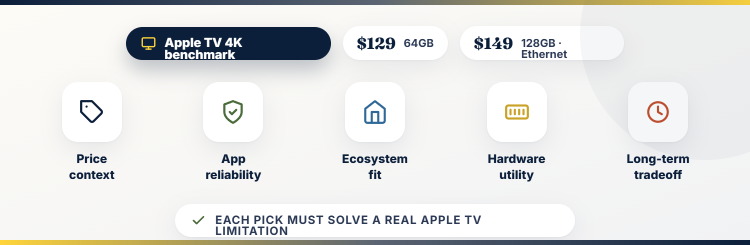
Apple TV’s speed creates an unfair comparison if price is ignored, while cheap Android boxes look better than they are when certification and updates are ignored. I prioritized current official information and the complete living-room experience. Devices earned a place by solving a real Apple TV limitation, maintaining reputable app access, and providing a clear reason to accept their compromises.
- Price Context: Every device was compared with Apple’s current $129 64GB model and $149 128GB Ethernet model rather than an outdated launch price.
- App Reliability: Mainstream certification, DRM, regional availability, update support, and service compatibility mattered more than the size of an unofficial application catalog.
- Ecosystem Fit: Alexa, Google Home, AirPlay, HomeKit, casting, Android flexibility, and specialist home-theater workflows were assessed according to the household they serve.
- Hardware Utility: Ethernet, Wi-Fi, storage, USB, HDMI input, remote features, codec support, and server capability had to improve real use rather than specifications alone.
- Long-Term Tradeoff: I considered product age, operating-system direction, manufacturer support, advertisements, privacy, and the likelihood that the device remains comfortable after setup.
What You Give Up When Leaving Apple TV
The obvious loss is not raw speed; it is cohesion. Purchases, passwords, AirPods, Apple Arcade saves, HomeKit scenes, Photos, FaceTime behavior, and familiar accessibility settings may not transfer. AirPlay support on Roku or Google devices preserves some casting, but it does not recreate tvOS. Decide which Apple integrations are used weekly before allowing a lower device price to drive the entire decision.
- Apple Purchases: Movies and shows may remain available through the Apple TV app on supported platforms, but store behavior and feature parity can vary.
- AirPods Experience: Bluetooth works broadly, yet automatic switching, spatial-audio behavior, shared audio, and device discovery are usually smoother inside Apple’s own ecosystem.
- Apple Arcade: Most alternatives cannot reproduce the same Apple Arcade catalog, controller support, progress, and family-sharing experience available through tvOS.
- HomeKit Control: Roku supports HomeKit and AirPlay, while other platforms may emphasize Google Home or Alexa instead of Apple’s complete smart-home workflow.
- Privacy Difference: Advertising identifiers, home-screen promotions, voice processing, and recommendation data practices differ, so review platform controls rather than assuming equal treatment.
Picture, Audio, and Networking Differences
All nine alternatives can produce excellent 4K streaming, but a logo on the box is only one link in the chain. The app, subscription tier, title, HDMI connection, television, receiver, and regional service must support the same format. Apple’s Ethernet model costs more; several rivals include wired networking at lower prices, while sticks and some boxes require adapters.
- Dolby Vision: Confirm both the device and exact service application support Dolby Vision; Formuler lists HDR10+ but not Dolby Vision on its official Z11 specifications.
- Dolby Atmos: Atmos availability depends on the app, title, plan, television or receiver, output mode, and whether the device decodes or passes through the format.
- Ethernet Choice: Roku Ultra, Google TV Streamer, Shield TV Pro, and Formuler include wired networking, avoiding the Wi-Fi-only limitation of Apple’s cheaper configuration.
- Local Formats: Shield and Formuler expose more ports and codec-oriented flexibility, while Roku USB playback and Apple applications follow more controlled compatibility paths.
- Network Reality: Stable 25–50Mbps delivery can outperform a faster but congested link; wire the device when high-bitrate local files or unreliable Wi-Fi justify it.
Move from Apple TV Without Breaking Your Setup
Treat the new device as a trial rather than an immediate replacement. Verify essential services, picture formats, family accounts, subtitles, accessibility options, local files, and remote controls during the retailer’s return period. Keep Apple TV connected until the alternative survives normal evening use. This is particularly important when moving to Android hardware whose service certification or interface differs by region.
- List Essentials: Record every app, Apple purchase, family profile, game, smart-home control, accessibility feature, and local-media workflow that must survive the migration.
- Check Regions: Confirm the exact device model and streaming applications are officially supported in your country before importing hardware or relying on another market’s reviews.
- Rebuild Accounts: Use a password manager and two-factor access to sign into services securely; avoid restoring credentials from untrusted setup applications or unofficial backups.
- Test Formats: Play known Dolby Vision, HDR10+, Atmos, subtitle, frame-rate, and local-media examples through the intended television and receiver configuration.
- Keep Perspective: Our Roku versus Firestick guide helps separate platform differences if your final choice narrows to those two ecosystems.
Verdict:
Apple TV remains the best fit for committed Apple households, but it is no longer the automatic premium choice at $129–$149. Fire TV Cube offers stronger Alexa and equipment control, Roku Ultra delivers simplicity at half the entry price, and Google TV Streamer balances profiles, casting, smart-home tools, storage, and Ethernet. Shield and Formuler serve specialist users.
- Amazon Fire TV Cube: Best for Alexa households that want hands-free commands, HDMI input, strong device control, Wi-Fi 6E, and premium streaming formats.
- Roku Ultra: Best for families seeking a simple premium interface, excellent rechargeable remote, Ethernet, Wi-Fi 6, Dolby formats, AirPlay, and HomeKit support.
- Google TV Streamer (4K): Best for Android and Google households that value casting, 32GB storage, Ethernet, profiles, smart-home controls, and a lower price than Apple TV.
FAQs
What is the best alternative to Apple TV 4K?
Google TV Streamer is the best balanced alternative for most non-Apple households. Roku Ultra is simpler, Fire TV Cube provides stronger Alexa control, and NVIDIA Shield TV Pro is better for Kodi and local media.
Which Apple TV alternative supports AirPlay?
Roku Ultra officially supports Apple AirPlay and HomeKit. Some Google TV applications or television features may offer casting options, but they do not reproduce the complete tvOS and Apple ecosystem experience.
Is Roku Ultra better than Apple TV?
Roku Ultra is cheaper and easier for straightforward streaming, with Ethernet, Wi-Fi 6, Dolby formats, USB playback, and a premium remote. Apple TV is faster and integrates more deeply with Apple devices and services.
Can Android TV replace Apple TV for Kodi?
Yes. NVIDIA Shield TV Pro is often the stronger Kodi choice because it offers Android TV, USB ports, Ethernet, local storage options, and broad codec support. Apple TV requires a different application and installation ecosystem.
Can I use Stremio on an Apple TV alternative?
Stremio availability varies by platform. Google TV and Android TV provide the clearest supported television route, while our Stremio on Apple TV guide explains the current Apple-specific limitations and workarounds.