
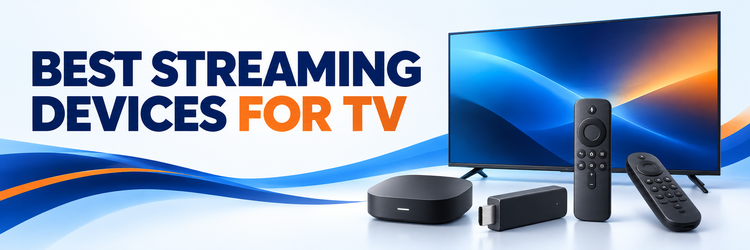
The best streaming devices for TV should make entertainment faster, easier to find, and more reliable than the software already built into the screen. The right choice depends on platform preference, picture formats, networking, storage, smart-home integration, and whether the player will handle local media as well as subscription apps.
This 2026 roundup compares nine current devices using official specifications and availability information. It separates premium boxes, compact sticks, and budget alternatives so you can spend on features that improve your room instead of paying for connections, formats, or ecosystem extras you will never use.
Top Recommendations at a Glance
| Device | Best For | Picture & Audio | Get Started |
|---|---|---|---|
| Apple TV 4K | Overall | Dolby Vision, HDR10+, HDR10, and HLG support cover the major modern HDR formats, while Dolby Atmos handles immersive audio on compatible systems | Visit Site |
| Roku Ultra | for Simple Premium Streaming | Wi-Fi 6 improves wireless capacity on compatible routers, while the built-in 10/100 Ethernet port offers a predictable wired alternative for congested rooms | Visit Site |
| Google TV Streamer (4K) | for Google Home | Four gigabytes of memory and 32GB of storage provide substantially more breathing room for apps than older entry-level Google TV devices offered | Visit Site |
| NVIDIA Shield TV Pro | for Local Media and Power Users | Dolby Vision HDR and Dolby Atmos support serve modern movie libraries, with additional audio passthrough options valuable to receiver-based home theaters | Visit Site |
| Amazon Fire TV Cube (3rd Gen) | for Hands-Free Alexa Control | Hands-free Alexa microphones support voice navigation and compatible smart-home commands even when the included remote is sitting across the room | Visit Site |
1) Apple TV 4K — Best Overall
Apple TV 4K is the most complete premium choice for viewers who value speed, long-term polish, strong privacy controls, and excellent video matching. I rank it first because the A15 Bionic chip, broad HDR support, dependable app ecosystem, and clean interface make it equally convincing for everyday streaming, Apple services, smart-home control, and casual gaming.
Features:
- The A15 Bionic chip keeps navigation, app launches, high-bitrate playback, and supported games consistently responsive without crowding the television with a bulky enclosure.
- Dolby Vision, HDR10+, HDR10, and HLG support cover the major modern HDR formats, while Dolby Atmos handles immersive audio on compatible systems.
- The Siri Remote combines a touch-enabled clickpad, dedicated power and mute controls, USB-C charging, and voice search in a compact aluminum design.
- The 64GB model uses Wi-Fi, while the 128GB version adds Gigabit Ethernet and Thread networking for more flexible home-theater and smart-home installations.
- Frame-rate and dynamic-range matching can reduce conversion artifacts when apps expose the proper content metadata, preserving a more faithful viewing experience.
- I prefer its uncluttered tvOS interface for households that want recommendations and apps without an aggressively promotional home screen dominating every session.
- AirPlay, Apple Music, Apple Arcade, Fitness+, HomeKit, and iCloud Photos make the box especially cohesive for viewers already using Apple devices and services.
| Pros | Cons |
|---|---|
| Fast, polished tvOS experience | Costs more than most streaming sticks |
| Excellent HDR and audio support | HDMI cable is sold separately |
| Strong privacy and Apple ecosystem integration | |
| Long software-support reputation |
Pricing:
- 64GB Wi-Fi model: $129 from Apple
- 128GB Wi-Fi + Ethernet model: $149 from Apple
- AppleCare+ and HDMI cable are optional extras
Link: https://www.apple.com/shop/buy-tv/apple-tv-4k/128gb
2) Roku Ultra — Best for Simple Premium Streaming
Roku Ultra pairs a familiar, app-first interface with premium conveniences that cheaper Roku players omit. I recommend it for mixed-platform households because Wi-Fi 6, Ethernet, Dolby Vision, rechargeable remote controls, and broad channel availability work without demanding loyalty to one phone brand, assistant, or media-store ecosystem. Setup remains approachable for less technical viewers too.
Features:
- The current Ultra supports 4K, HDR10+, Dolby Vision, and Dolby Atmos, covering the picture and sound formats most premium television owners expect.
- Wi-Fi 6 improves wireless capacity on compatible routers, while the built-in 10/100 Ethernet port offers a predictable wired alternative for congested rooms.
- Roku Voice Remote Pro includes backlit buttons, USB-C recharging, hands-free voice commands, a lost-remote finder, and two programmable shortcut buttons.
- A USB 3.0 port permits playback of compatible local media, providing a useful fallback for personal videos, photos, and music collections.
- Roku says this generation is over 30 percent faster than its other players, helping searches, home-screen movement, and channel launches feel immediate.
- I value private listening through paired Bluetooth headphones when late-night viewing would otherwise disturb family members or neighbors in nearby rooms.
- The neutral platform carries major subscription services and free ad-supported channels without requiring an Apple, Google, or Amazon content library.
| Pros | Cons |
|---|---|
| Straightforward interface for most households | Ethernet port is limited to 100 Mbps |
| Premium rechargeable remote | Home screen still contains advertising |
| Wi-Fi 6 plus wired Ethernet | |
| Dolby Vision and Atmos support |
Pricing:
- $149.99 regular price listed by Roku
- Promotional pricing can reduce the direct-store cost
- No separate subscription is required for Roku OS
Link: https://www.roku.com/products/roku-ultra
3) Google TV Streamer (4K) — Best for Google Home
Google TV Streamer replaces the old Chromecast dongle with a faster tabletop box designed for entertainment and connected-home control. I place it third for its 32GB storage, 4GB memory, wired networking, Matter support, Thread border router, and personalized Google TV discovery. It is particularly sensible beside Nest cameras, Android phones, and Google Photos.
Features:
- The player outputs up to 4K at 60 frames per second and supports Dolby Vision, HDR10, HDR10+, HLG, and Dolby Atmos.
- Four gigabytes of memory and 32GB of storage provide substantially more breathing room for apps than older entry-level Google TV devices offered.
- Gigabit Ethernet is built into the enclosure, avoiding a separate networking adapter when stable wired playback matters more than a hidden installation.
- Google TV organizes recommendations across supported services, while the redesigned voice remote includes customizable and remote-finder controls for easier daily use.
- Matter compatibility and an integrated Thread border router let the streamer participate in a broader Google Home setup beyond television playback.
- I recommend its ambient mode for displaying Google Photos collections or curated artwork when the television is idle but remains visible in the room.
- The box uses USB-C power and HDMI 2.1 output, although Google does not include the required HDMI cable in the retail package.
| Pros | Cons |
|---|---|
| Generous 32GB storage and 4GB memory | HDMI cable is not included |
| Built-in Gigabit Ethernet | Recommendation screen can feel content-heavy |
| Matter and Thread smart-home support | |
| Broad HDR format compatibility |
Pricing:
- Google Store pricing varies by country and promotion
- No mandatory Google TV platform fee
- Streaming-service subscriptions are purchased separately
Link: https://store.google.com/product/google_tv_streamer?hl=en-US
4) NVIDIA Shield TV Pro — Best for Local Media and Power Users
NVIDIA Shield TV Pro remains the specialist choice for demanding local libraries, expandable peripherals, and game streaming. I keep it high in this list because its Tegra X1+ processor, AI upscaling, dual USB ports, Plex Media Server capability, Gigabit Ethernet, and mature Android TV software still provide flexibility that compact consumer sticks rarely match.
Features:
- The Tegra X1+ processor powers responsive Android TV navigation and NVIDIA AI-enhanced upscaling for supported lower-resolution video on compatible 4K televisions.
- Dolby Vision HDR and Dolby Atmos support serve modern movie libraries, with additional audio passthrough options valuable to receiver-based home theaters.
- Two USB 3.0 ports accept storage and compatible accessories, making the Pro notably easier to expand than sealed streaming sticks or minimalist boxes.
- Gigabit Ethernet offers ample local-network bandwidth for high-bitrate media, while dual-band Wi-Fi and Bluetooth cover conventional wireless connections and accessories.
- Plex Media Server capability can turn the Shield into a compact library host, although serious collections still benefit from dedicated network storage.
- I choose the Pro model over the tube-shaped Shield when USB expansion, 3GB memory, and server features matter more than the smallest footprint.
- GeForce NOW support adds cloud gaming, and the Google Play catalog supplies mainstream streaming apps, media players, utilities, and compatible games.
| Pros | Cons |
|---|---|
| Powerful local-media capabilities | Premium hardware price |
| Useful AI upscaling | Older platform than newer mainstream boxes |
| Gigabit Ethernet and two USB ports | |
| Plex Media Server support |
Pricing:
- $199.99 listed price from NVIDIA
- GeForce NOW memberships are optional
- Plex Pass features may require a separate purchase
Link: https://www.nvidia.com/en-us/shield/
5) Amazon Fire TV Cube (3rd Gen) — Best for Hands-Free Alexa Control
Fire TV Cube combines a capable streamer with far-field Alexa microphones and equipment control for a voice-first living room. I favor it for viewers who want to launch shows, manage compatible televisions, or check smart-home devices without reaching for a remote. HDMI input, Wi-Fi 6E, Dolby Vision, and 16GB storage deepen its appeal.
Features:
- The octa-core processor combines four 2.2GHz and four 2.0GHz cores, giving Fire OS considerably more headroom than inexpensive Amazon streaming sticks.
- Hands-free Alexa microphones support voice navigation and compatible smart-home commands even when the included remote is sitting across the room.
- An HDMI input can display compatible cable or satellite equipment through the Cube, consolidating voice control and source switching in one setup.
- Wi-Fi 6E supports compatible tri-band routers, while the included Ethernet adapter offers a wired connection limited to 10/100 Mbps performance.
- Dolby Vision, HDR10+, HLG, Dolby Atmos, and AV1 decoding cover the principal modern streaming formats and improve compatibility with newer services.
- I recommend the Cube primarily when its microphones, equipment control, and HDMI input will be used, because those extras justify the larger footprint.
- Sixteen gigabytes of internal storage doubles many older Fire TV sticks, leaving more practical room for streaming apps, utilities, and cached data.
| Pros | Cons |
|---|---|
| Fast Fire TV performance | More expensive and visible than a stick |
| Hands-free Alexa microphones | Included Ethernet is only 100 Mbps |
| Useful HDMI input and equipment control | |
| Wi-Fi 6E support |
Pricing:
- Amazon pricing varies by country and promotion
- No mandatory Fire TV platform fee
- Subscription services and optional accessories cost extra
Link: https://developer.amazon.com/docs/device-specs/device-specifications-fire-tv-cube.html
6) Amazon Fire TV Stick 4K Max (2nd Gen) — Best Compact Fire TV
Fire TV Stick 4K Max delivers Amazon’s strongest stick-class specifications without placing a box beneath the television. I suggest it for Prime Video and Alexa households needing Wi-Fi 6E, 16GB storage, broad HDR support, and AV1 decoding in a travel-friendly form. Fire OS also offers extensive apps, live channels, and smart-home integrations.
Features:
- The 2.0GHz quad-core processor and 2GB memory give this second-generation Max more responsiveness than Amazon’s lower-priced HD and 4K sticks.
- Sixteen gigabytes of storage provides welcome extra room for apps compared with many mainstream streaming sticks that ship with only 8GB.
- Wi-Fi 6E can use the 6GHz band with compatible routers, potentially reducing interference in homes crowded with older wireless devices.
- Dolby Vision, HDR10+, HLG, Dolby Atmos, and AV1 decoding support a broad mix of premium video, audio, and efficient streaming formats.
- The Alexa Voice Remote Enhanced adds television controls, channel buttons, and customizable keys while keeping spoken search central to the Fire TV experience.
- I like the compact HDMI-stick design for wall-mounted televisions, guest rooms, and travel bags where a full-size streaming box feels unnecessarily cumbersome.
- Optional Ethernet adapters and USB accessories expand connectivity, but they add cables and may require compatible power accessories for reliable operation.
| Pros | Cons |
|---|---|
| Strong performance in a compact stick | Home screen strongly promotes Amazon content |
| 16GB internal storage | Ethernet requires an optional adapter |
| Wi-Fi 6E and broad HDR support | |
| Deep Alexa and Prime integration |
Pricing:
- Amazon pricing varies by country and promotion
- No mandatory Fire TV platform fee
- Optional Ethernet and accessory adapters cost extra
7) onn. 4K Pro Streaming Device (2026) — Best Budget Google TV Box in the US
Walmart’s 2026 onn. 4K Pro is an unusually complete budget box for buyers in the United States and Puerto Rico. I include it because 32GB storage, 3GB memory, Wi-Fi 6, Ethernet, Dolby Vision, Dolby Atmos, USB expansion, and hands-free voice features undercut many premium competitors while retaining the familiar Google TV catalog.
Features:
- The 2026 model combines 3GB memory with 32GB storage, offering more useful app capacity than numerous low-cost sticks and older Google TV boxes.
- Its 4K output supports Dolby Vision and Dolby Atmos, bringing premium picture and sound formats to a device positioned around budget pricing.
- Wi-Fi 6, an Ethernet port, Bluetooth, and USB 2.0 create a notably flexible connection set for local accessories and varied home networks.
- Google TV with Gemini provides cross-service discovery, voice assistance, casting, profiles, and access to the mainstream Android television application ecosystem.
- Hands-free microphones can control playback and compatible smart-home devices, while a physical switch lets privacy-conscious households completely disable voice listening.
- I rate its remote finder as a genuinely useful family-room feature because a misplaced controller can be located without searching every cushion manually.
- Availability is the main limitation: Walmart markets the onn. line primarily in the United States and Puerto Rico rather than as a global product.
| Pros | Cons |
|---|---|
| Excellent specifications for the price | Limited geographic availability |
| 32GB storage and 3GB memory | Budget hardware support may be less predictable |
| Ethernet and USB connectivity | |
| Dolby Vision and Atmos support |
Pricing:
- $59.98 listed at Walmart during research
- No mandatory Google TV platform fee
- Streaming subscriptions remain separate purchases
8) Roku Streaming Stick Plus (2025) — Best Simple Budget Stick
Roku Streaming Stick Plus is a compact, approachable option for viewers who prioritize easy navigation over premium hardware extras. I pick it for secondary televisions, dorm rooms, and uncomplicated upgrades because it delivers 4K HDR, voice search, TV controls, Bluetooth headphone listening, and USB-C power while remaining smaller and less expensive than Roku’s flagship box.
Features:
- The slim stick streams up to 4K and supports HDR10+, giving compatible budget televisions a sharper, more dynamic image than basic HD players.
- Roku’s home screen emphasizes installed channels and universal search, keeping daily navigation familiar for households with mixed technical confidence levels.
- The included voice remote controls television power and volume, reducing the need to keep a second controller nearby during routine viewing.
- Bluetooth headphone mode enables private listening through compatible wireless audio devices, a convenient feature for shared bedrooms and late-night television sessions.
- USB-C power can draw from a compatible television port, helping the stick avoid another wall adapter when the display supplies adequate power.
- I recommend it when simplicity and size matter more than Dolby Vision, wired Ethernet, USB storage, or a rechargeable premium remote control.
- Dual-band Wi-Fi supports common home routers, but buyers with difficult wireless conditions should consider a box offering Wi-Fi 6 or Ethernet.
| Pros | Cons |
|---|---|
| Simple Roku interface | No Dolby Vision support |
| Compact USB-C-powered design | No built-in Ethernet or USB expansion |
| Voice remote with television controls | |
| Affordable 4K HDR10+ playback |
Pricing:
- $59.99 regular price listed by Roku
- Promotional prices may be lower
- No mandatory Roku OS subscription
Link: https://www.roku.com/products/roku-express-4k-plus
9) Xiaomi TV Box S (3rd Gen) — Best Globally Available Budget Google TV Box
Xiaomi TV Box S third generation brings a capable Google TV experience to markets where Walmart’s onn. hardware is unavailable. I choose it as the global budget alternative because it combines 4K output, Dolby Vision, HDR10+, Dolby Atmos, DTS:X, Wi-Fi 6, 32GB storage, Google Cast, and a compact enclosure suited to everyday subscription streaming.
Features:
- A 6nm quad-core Cortex-A55 processor running up to 2.5GHz improves responsiveness, supported by 2GB memory and 32GB of internal storage.
- Dolby Vision and HDR10+ handle premium high-dynamic-range video, while Dolby Atmos and DTS:X broaden compatibility with capable home sound systems.
- Wi-Fi 6 supports newer routers and busy wireless environments, although the compact box does not include a built-in wired Ethernet port.
- Google TV recommendations, Google Cast, voice search, profiles, and Play Store applications provide the familiar Android-based experience across supported regions.
- The Bluetooth remote includes directional controls and voice input, keeping television navigation conventional even when spoken discovery is not desired.
- I view 32GB storage as its strongest practical upgrade because larger app libraries are easier to manage than on older 8GB boxes.
- Regional pricing, apps, certifications, and retailer support can differ, so buyers should confirm the official local model before placing an order.
| Pros | Cons |
|---|---|
| Broad HDR and audio format support | Only 2GB memory |
| Wi-Fi 6 and 32GB storage | No built-in Ethernet port |
| Compact Google TV design | |
| Sold across more markets than onn. |
Pricing:
- Pricing varies by official regional retailer
- No mandatory Google TV platform fee
- Subscriptions and optional accessories cost extra
Link: https://www.mi.com/global/product/xiaomi-tv-box-s-3rd-gen/
Choose the Right Streaming Platform Before Comparing Hardware
The operating system shapes daily use more than small processor differences. Start with the services, phones, smart-home devices, and people already in the household, then narrow the hardware.
- Apple households: Apple TV 4K makes AirPlay, Photos, Apple Music, HomeKit, and account setup feel cohesive, but that integration matters less if nobody uses Apple services.
- Simple shared televisions: Roku keeps the learning curve low and avoids requiring one dominant mobile ecosystem, making it comfortable for guests, children, and mixed-device families.
- Google and Android homes: Google TV combines casting, Google Photos, Play Store apps, and connected-home controls, with stronger hardware choices now available at several prices.
- Alexa and Prime Video users: Fire TV puts Alexa and Amazon discovery at the center, which is convenient for existing customers but visually busier for viewers wanting neutrality.
- Local media enthusiasts: NVIDIA Shield TV Pro earns its premium through USB expansion, network throughput, format flexibility, and server features rather than ordinary subscription-app playback alone.
Match Picture and Audio Features to Your Television
A device cannot improve formats the display or sound system does not support. Check the complete signal chain—including television, receiver, soundbar, HDMI input, and content service—before paying for badges.
- Resolution and frame rate: Every selection here reaches 4K, but premium sports, games, and interface animation benefit when the player reliably outputs 60 frames per second.
- HDR formats: Dolby Vision is common on premium boxes, while HDR10+ matters on certain televisions and services; Roku Streaming Stick Plus omits Dolby Vision.
- Audio support: Dolby Atmos compatibility does not guarantee Atmos from every app or title, and the television or receiver must also accept the chosen format.
- Matching controls: Apple TV can match frame rate and dynamic range, reducing unnecessary conversion when an application supplies correct metadata and the display switches cleanly.
- Cable quality: Boxes normally require HDMI cables, and premium models may omit them; use a certified cable appropriate for the display and receiver bandwidth.
Plan for Wi-Fi, Ethernet, Ports, and Storage
Networking and expansion determine whether a streamer remains dependable after more apps, higher-bitrate video, or local accessories enter the setup. A faster processor cannot compensate for unstable connectivity.
- Wireless generation: Wi-Fi 6 and 6E can improve capacity with compatible routers, but placement and interference remain more important than the logo printed on the box.
- Wired networking: Apple TV 4K 128GB, Google TV Streamer, Shield Pro, Roku Ultra, Fire TV Cube, and onn. 4K Pro provide Ethernet in different forms and speeds.
- Stick adapters: Compact Fire TV hardware needs an optional adapter; this guide to a Firestick Ethernet adapter setup explains the practical cabling tradeoffs.
- App storage: Sixteen or 32GB reduces routine app juggling, while large offline libraries and server workloads still belong on expandable or network-attached storage.
- Accessory ports: Shield Pro offers two USB 3.0 ports and onn. includes USB 2.0; minimalist boxes often trade these connections for smaller dimensions.
Budget for the Complete Streaming Setup
The shelf price is only one part of ownership. Account for cables, network adapters, subscriptions, replacement remotes, storage, and regional availability before deciding that one device is cheaper.
- Premium boxes: Apple TV 4K, Roku Ultra, and Shield Pro cost more upfront, but their remotes, ports, memory, or specialist features may avoid later accessories.
- Affordable sticks: Roku Streaming Stick Plus and Fire TV Stick 4K Max minimize space and expense, though wired networking or expansion can increase the final bill.
- Budget boxes: The onn. 4K Pro offers exceptional US value, while Xiaomi provides a more internationally available route with pricing set by regional retailers.
- Service fees: None of these platforms requires a basic operating-system subscription, but Netflix, Disney+, sports packages, rentals, and cloud gaming remain separate purchases.
- Sale timing: Promotions change quickly, so compare official current listings and judge the hardware on features you will use rather than an expired discount.
Set Up a Streaming Device for Reliable Everyday Use
A few deliberate setup choices prevent most buffering, control, and account frustrations. Complete updates first, then tune picture settings and app access while the packaging is still available.
- Update immediately: Install current system and remote firmware before evaluating speed or compatibility, because retail units may have spent months boxed in distribution.
- Check power: Use the supplied power adapter unless the manufacturer explicitly supports television USB power; underpowered sticks can restart or behave unpredictably.
- Tune display output: Select the correct HDMI input mode, verify HDR detection, and consider frame-rate matching only after confirming the television switches without blank-screen problems.
- Secure accounts: Enable purchase PINs, child profiles, and two-factor authentication where available, then remove unused apps and sign out before selling the device.
- Test the network: Compare wired and wireless playback with the same demanding title, then reposition the router or streamer instead of assuming advertised Wi-Fi speed guarantees stability.
Verdict: Which Streaming Device Should You Buy?
Apple TV 4K earns the top position because its speed, clean interface, broad format support, privacy controls, and ecosystem depth create the fewest compromises. Roku Ultra is the strongest simple premium alternative, while Google TV Streamer delivers better storage and smart-home flexibility for Google-centered households. Choose NVIDIA Shield for serious local media, Fire TV for Alexa, and the budget models when value or regional access matters most.
- Apple TV 4K — best overall
- Roku Ultra — best simple premium option
- Google TV Streamer (4K) — best for Google Home
Frequently Asked Questions
What is the best streaming device for TV overall?
Apple TV 4K is the strongest all-around choice for speed, format support, privacy, software polish, and long-term usability. Roku Ultra is easier to recommend when platform neutrality and a premium remote matter more than Apple integration.
Is a streaming box better than a smart TV interface?
Often, yes. A separate player can provide faster navigation, newer apps, longer updates, and a replaceable platform. A modern television with responsive software may not need one, so upgrade only when the built-in experience creates a real limitation.
Should I choose Roku or Fire TV?
Roku generally favors a simpler, more neutral interface, while Fire TV emphasizes Alexa and Amazon services. Our detailed Roku versus Firestick comparison explains the platform differences before you choose hardware.
Do I need Dolby Vision and Dolby Atmos?
Only if the television, sound system, streaming service, and chosen title support them. HDR10 remains broadly compatible, and ordinary stereo or surround sound can still be excellent. Buy for the complete setup rather than a single badge.
How much storage should a streaming device have?
For mainstream subscriptions, 16GB is workable and 32GB is more comfortable. Large app libraries, games, downloads, and local media benefit from additional space, USB expansion, or network storage. Available capacity is always lower than the advertised total.
Can I use a streaming device on any television?
The television needs a compatible HDMI input, and 4K or HDR playback requires matching display support. Older sets can usually show a lower resolution, but HDCP, power, or receiver compatibility may still limit certain protected services.