


Key Takeaway: The revised FREE Linux IPTV Players evaluation focuses on official applications, format compatibility, identifiable operators, current platform guidance, and limitations explained before signup. Finding a solid IPTV player on Linux is mostly about stability, codec support, and playlist handling. Options like Kodi, VLC Media Player, and IPTVnator lead the pack for different reasons, from a full media center experience to lightweight playback and clean M3U management. This review helps you pick confidently.
Are you tired of setting up an IPTV player on Linux, only to deal with buffering, broken channels, and settings that never seem to stick? If you have tried low-quality or unverified options, you have likely faced sudden stream drops, unsafe add-ons, privacy risks, buggy EPG guides, poor codec support, and even random crashes that waste your time. The worst part is that these issues can turn a relaxing movie night into constant troubleshooting.
A reliable player fixes that. You get smoother playback, cleaner playlists, accurate guides, and a setup you can trust.
Important Note: The services discussed for FREE Linux IPTV Players may change by region, device generation, plan, and authorized catalog. Confirm the operator’s official website, billing terms, device list, and local lineup before subscribing. The recommendations avoid unknown feeds, mirror-domain chains, and platforms unable to identify their distribution basis.
Best Linux IPTV Players: Top Recommendations!
| Tool Name | Platform | Price | Get Started |
|---|---|---|---|
| Kodi | Linux | Free | Visit Site |
| VLC Media Player | Linux | Free | Visit Site |
| IPTVnator | Linux | Free | Visit Site |
| Hypnotix | Linux | Free | Visit Site |
| Megacubo | Linux | Free | Visit Site |
1) Kodi
Kodi is a well-known solution that aims to turn your Linux system into a clean, engaging media center. In my opinion, it is one of the easiest ways to manage IPTV with a simple interface. It allows you to organize channels, playlists, and guides in one place. I tested it on Linux and found the setup clear once you know which add-ons are needed. Keep in mind you may need a PVR client and a playlist link from your provider in order to start watching.
Features:
- PVR IPTV Client Integration: Kodi supports IPTV playback via the PVR IPTV Simple Client. It allows you to add M3U playlists and XMLTV EPG sources. I tested this on Linux and channel loading was stable. It helps you keep live streams and guide data together.
- EPG Integration with Logos: Kodi offers EPG integration with channel logos and timeline views. It allows you to map guide data to channels. This may help when you switch between sports, news, and movies quickly. Customization options keep the grid easy to read.
- Timeshift Support: Kodi includes timeshift support when the backend provides it. It helps you pause and rewind live channels. I suggest enabling buffering settings after setup. Start with small buffer values to avoid stutter.
- Remote-Friendly Navigation: Kodi works with remote control apps and keyboard-friendly navigation. It allows you to run Kodi like a TV interface. I could access core controls from my phone on Wi-Fi. This may help if your Linux box sits across the room.
- Extensive Add-on Ecosystem: Kodi has an add-on ecosystem for IPTV-related workflows. It helps you extend playback, subtitles, and metadata. Many tools are optional, so you can keep it light. Stick to reputable add-ons only.
- Hardware Acceleration Options: Kodi provides hardware acceleration options on Linux for smoother streams. It allows you to leverage VAAPI or similar decoders when available. I noticed CPU load dropped during 1080p playback. This is essential for small PCs.
- Advanced M3U Parsing: Kodi offers per-channel stream overrides and advanced M3U parsing options. It helps you handle odd playlist formats. I was able to fix missing channels by adjusting M3U cache settings. This lesser-known control improves reliability.
| Pros | Cons |
| It allowed me to manage IPTV channels inside one interface | Setup can feel complex for first-time Linux users |
| Strong customization offered me a clean living-room layout | Some IPTV streams may buffer depending on provider stability |
| I could access EPG views that made scheduling feel simple | Add-on choices can be risky without reputable sources |
| High-quality playback with acceleration helped on low-power hardware |
Link: https://kodi.tv/download/
2) VLC Media Player
VLC Media Player is a well-known, reputable solution that aims to make IPTV playback on Linux simple and reliable. I tested it for common IPTV tasks like opening M3U playlists and streaming network channels. It is one of the easiest options to start with since it often works right after install. It allows you to avoid extra plug-ins and keep playback in one place.
Features:
- M3U Playlist Playback: VLC plays M3U and M3U8 IPTV playlists on Linux with minimal setup. It allows you to load local files or network links. Streams start fast and playback controls stay simple.
- Wide Network Protocol Support: VLC supports UDP, RTP, and HTTP network streams that many IPTV providers rely on. I tested multicast playback on a Linux LAN and it stayed stable. Buffering controls helped reduce stutter.
- EPG-Friendly Workflow: VLC offers an EPG-friendly workflow when a provider supplies program data separately. You can keep playlist and guide files organized. It is important to map sources carefully. Navigation feels familiar.
- Advanced Caching Controls: VLC includes lesser-known advanced caching and clock sync options for tricky streams. Increasing network caching for choppy channels can reduce stutter. It may help on unstable provider connections.
- Audio and Subtitle Control: VLC provides audio and subtitle track controls that matter for international IPTV channels. It allows you to switch tracks quickly. I could access delay settings, so lip sync becomes manageable.
- Stream Recording: VLC supports recording streams to file when the stream format permits it. You can save live segments for later. It helps you keep copies for offline viewing.
- Customizable Hotkeys and Filters: VLC offers customization through hotkeys, filters, and interface tweaks on Linux. Setting profiles per stream type is a good idea. I evaluated profiles and switching became faster.
| Pros | Cons |
| M3U playlist playback was smooth and I could start quickly | Some IPTV lists load slowly when they contain many entries |
| It allowed me to tune buffering for unstable streams easily | Channel groups can feel clumsy without a dedicated IPTV interface |
| Audio and subtitle switching is fast across many channel types | EPG handling is basic compared with dedicated IPTV clients |
| It is one of the easiest players to install on Linux |
Link: https://www.videolan.org/
3) IPTVnator
IPTVnator is a well-known, reputable solution I checked for playing IPTV on Linux in a clean, focused way. It aims to keep setup simple, so all you need is a playlist link or file and a current stream source. I like how it helps you avoid messy workflows by keeping channels, categories, and playback in one place. If you are starting out, it is important to keep in mind that stream quality depends on your provider, but IPTVnator makes day-to-day viewing easier.
Features:
- M3U Playlist Support: IPTVnator has built-in support for M3U and M3U8 playlists. I tested it with a local file and a remote URL. Channels loaded quickly and stayed organized.
- XMLTV EPG Support: IPTVnator supports EPG via XMLTV so you can see what is on now and next. It links guide data to channels when IDs match. This may help reduce channel hopping.
- Group and Category Browsing: IPTVnator keeps large playlists manageable through group and category browsing. It lets you filter channels by group names from the playlist. Navigation stayed clear even with hundreds of entries.
- Fast Search and Filtering: IPTVnator includes search and quick filtering to help you find a channel fast. While using this feature one thing I noticed was consistent results across big lists. Use short keywords first to narrow matches quickly.
- Favorites Pinning: IPTVnator lets you pin channels you watch the most as favorites. I was able to mark items in one click. It made repeat viewing much faster.
- Recent Channels View: IPTVnator shows recent channels and resume-style behavior to help you continue where you left off. It keeps your last watched items visible. Clear recents if you share your desktop profile.
- Local Data Storage: IPTVnator stores your playlists and settings locally for availability between sessions. This is a lesser-known convenience for Linux setups. It reduces repeated imports after restarts.
| Pros | Cons |
| It allowed me to add M3U URLs quickly and reliably | Some streams failed because codec support depends on your system |
| Clean interface keeps channels readable even with very large lists | EPG matching needs correct IDs so setup can take time |
| I could access favorites fast which improved daily viewing flow | No built-in playlist discovery, you must bring your own sources |
| EPG view is helpful to plan viewing and avoid guesswork |
Link: https://iptvnator.com/
4) Hypnotix
Hypnotix is a Linux IPTV player from Linux Mint that aims to make streaming simple and tidy. I evaluated it as a lightweight solution for watching live TV streams on a desktop. It is great for beginners because the layout is clear and the key controls are easy to find. It allows you to browse channels, pick a stream, and start watching with minimal setup. I also like how it keeps things focused on playback, not clutter.
Features:
- M3U Playlist Support: Hypnotix accepts IPTV playlists in M3U format. This may help you bring channels from a provider quickly. Keep in mind playlist quality varies.
- Provider Management: Hypnotix lets you add and manage IPTV providers in one place. I tested switching between providers and it stayed smooth. It helps you avoid mixing channels unintentionally.
- Channel Grouping: Hypnotix shows channels organized by groups from the playlist. This is helpful to find sports, news, or movies faster. Keep group names clean for best results.
- Favorites for Quick Access: Hypnotix lets you mark channels as favorites. I found that it reduced repeated browsing during daily viewing. Star your most watched channels before long sessions.
- Search and Filtering: Hypnotix includes a search field for quick channel lookup. It typically matches names from the playlist. This may help when lists are large and messy.
- EPG Integration: Hypnotix can show program guide data if the provider includes it. This helps you plan what to watch next. Keep in mind EPG availability depends on the source.
- Built-in Sample Providers: Hypnotix ships with a curated provider list option. This is a lesser-known convenience for first setup. Replace samples with your trusted source after testing.
| Pros | Cons |
| Clean interface made it easy for me to start watching fast | EPG support depends on provider and can be inconsistent |
| It allowed me to manage multiple playlists without confusion | Some streams failed and I could not fix provider issues |
| Favorites offered me quick access to my regular channels | Limited advanced playback tweaks compared with VLC or MPV |
| Lightweight feel is great for older Linux machines |
Link: https://github.com/linuxmint/hypnotix
5) Megacubo
Megacubo is a well-known IPTV player for Linux that aims to make live TV streams feel simple and manageable, even if you are new. While reviewing it, I found that it is a great option when all you need is one place to browse channels, organize favorites, and keep playback steady. I like that it typically feels lightweight, yet it still offers customization that helps you shape the layout to your routine. In my testing, it was helpful to keep in mind the built-in discovery approach, since it can surface streams without forcing you to hunt through messy lists first.
Features:
- Channel Discovery Directory: Megacubo pulls in public listings and organizes them through directory browsing. I tested it on Linux and navigation stayed clear. It helps you avoid random links.
- M3U Playlist Support: Megacubo offers playlist support with M3U handling. You can add lists and keep them tidy. It allows you to sort channels quickly. Customization makes daily viewing easier.
- Favorites and Quick Access: Megacubo lets you pin channels you watch most for quick access. I found it helpful to reduce browsing time. Curating sections is a good idea.
- Built-in Playback Engine: Megacubo includes built-in playback with stream switching. It helps you move between channels without extra players. Test several sources and keep the most stable ones saved.
- Electronic Guide Style Browsing: Megacubo offers electronic guide style browsing where available. It can show program context when sources provide it. This may help planning while keeping the interface engaging.
- Search Across Large Lists: Megacubo provides search and filtering across large lists. It allows you to find channels by name fast. I could access results without long scrolling.
- Background Stream Monitoring: Megacubo includes lesser-known background monitoring for stream availability. It can flag dead entries and reduce wasted clicks. Prune weak sources weekly for reliability.
| Pros | Cons |
| Clean interface helped me access channels with less clutter | Some streams depend on source quality so playback may vary |
| Playlist handling offered me simple organization and faster switching | Setup can feel needed at first if you add many lists |
| I could access favorites quickly which kept viewing routines consistent | I received occasional broken listings from public directories |
| Lightweight feel runs smoothly on many Linux desktops |
Link: https://megacubo.tv/en/
6) FreeTUXTV
FreeTUXTV is a simple IPTV and web TV player that runs well on Linux. While reviewing, I found it great for playing live channels without extra clutter. It aims to keep setup clear, so beginners can start fast. In my testing, it helped me avoid messy channel lists by keeping streams organized and ready for daily playback.
Features:
- Playlist Import for IPTV: FreeTUXTV supports M3U and similar playlist formats. I tested it with large lists and it stayed responsive. It helps you keep channels grouped and searchable.
- Built-in Channel Library: FreeTUXTV comes with a curated directory of web TV stations. You can browse by category and region quickly. This may help when you do not have a provider list yet.
- Favorites and Quick Access: FreeTUXTV lets you mark channels as favorites for faster switching. The interface keeps them visible and easy to manage. Set favorites early to reduce daily scrolling.
- EPG Support: FreeTUXTV offers Electronic Program Guide support where available. It can read EPG data when your source provides it. Verify the EPG URL format before saving for best results.
- Fast Stream Switching: FreeTUXTV opens streams in a lightweight player view. Channel changes are quick when the source is stable. It is helpful to test two sources per channel for reliability.
- Local Channel Database: FreeTUXTV stores channel metadata and groups locally. This keeps your lists consistent between sessions. One lesser-known benefit is quicker reloads after restarts.
- Linux Desktop Integration: FreeTUXTV fits common Linux desktop workflows and menus. It typically runs without heavy dependencies beyond media backends. Keep your codecs installed for best playback.
| Pros | Cons |
| It allowed me to import M3U lists with minimal friction | EPG accuracy depends fully on the provider and source quality |
| I could access favorites quickly which reduced channel hunting time | Some streams fail if codecs are missing on your system |
| Clean layout is great for beginners who want straightforward playback | The interface can feel dated compared to newer IPTV apps |
| Lightweight performance on Linux even with large channel lists |
Link: https://github.com/freetuxtv/freetuxtv
7) Open TV
Open TV is a simple IPTV player for Linux that aims to keep setup clear and playback steady. While reviewing, I found it helpful to anyone who wants a solution without extra clutter. It is important if you want all you need for quick channel playback and basic navigation. I suggest it for beginners who prefer a lightweight app and want to avoid complex settings early on.
Features:
- Simple M3U Loading: Open TV keeps channel setup simple with M3U playlist loading. You typically add a local file or a direct link. It helps you start watching quickly with minimal friction.
- Clean Player Window: Open TV builds live stream playback around a clean player window. I tested common IPTV streams and playback stayed stable. It is best for straightforward viewing without distractions.
- Fast Channel Browsing: Open TV is designed for fast channel list navigation. The layout makes it easier to jump between entries. This may help when managing larger playlists.
- EPG Support: Open TV can surface program context when EPG is available. I could access schedule data on compatible feeds during setup. Keep EPG sources consistent to reduce missing guide entries.
- Search and Filtering: Open TV reduces time spent scrolling through search and filtering. You can narrow channels by name quickly. It is a great way to handle long IPTV lists.
- Essential Configuration: Open TV focuses on essential configuration options instead of endless customization. You adjust core playback and list behavior. Keep defaults first and tune later.
- Lightweight Footprint: Open TV suits older Linux systems and low-resource setups with its lightweight footprint. I noticed it started fast and stayed responsive. Close heavy apps to keep streams smooth.
| Pros | Cons |
| Clean interface keeps viewing focused and reduces distractions | EPG reliability depends on provider data quality and formatting |
| It allowed me to add M3U playlists quickly without confusion | I could access fewer advanced playback controls than some rivals |
| Fast startup helped me access channels sooner on modest hardware | Limited customization may frustrate power users with specific needs |
| Search made it easier to locate channels in large lists |
Link: https://github.com/fredolx/open-tv
8) FastoTV Lite
FastoTV Lite is a simple IPTV player that aims to make Linux streaming feel less intimidating for beginners. I tested it as a lightweight option when I needed a clean interface and quick setup. It allows you to focus on playback instead of complex menus. If you are choosing from the most popular Linux IPTV players, this may help you get started without extra clutter, which is a key consideration for daily viewing.
Features:
- Playlist Import Support: FastoTV Lite supports common IPTV playlist formats like M3U. It allows you to add streams quickly. I checked loading speed and it stayed responsive. Great for basic channel lists.
- Minimal UI Design: FastoTV Lite is built as a Lite client with a clear, minimal UI. It helps you avoid distractions. Navigation is straightforward and keeping playlists organized is a good idea.
- Quick Channel Selection: FastoTV Lite provides a simple channel list view for quick selection. Playback starts with few steps. Try a smaller playlist first to confirm stability.
- Lightweight Design: FastoTV Lite keeps resource needs lower than heavy players. It can be helpful to users on modest hardware. I could access channels without major lag. Good for everyday viewing.
- Fast Playback Start: FastoTV Lite focuses on quick stream start with minimal prompts. It allows you to confirm a stream quickly. Check one channel per group to spot broken links early.
- Playlist Management Basics: FastoTV Lite supports adding and switching playlists without complex rules. It allows you to keep things tidy. Naming playlists clearly avoids confusion later.
- Open Source Base: FastoTV Lite has a developer-friendly open source base on GitHub. It allows customization for advanced users. I checked the repo structure and it was clear. A lesser-known benefit is easier auditability.
| Pros | Cons |
| Lightweight player ran smoothly on Linux during testing | Fewer advanced controls than full media players |
| Simple interface helps avoid confusion during daily IPTV viewing | Setup may require manual playlist handling for first-time users |
| Playlist loading felt quick and allowed me to start fast | Limited in-app guidance when streams failed to load |
| Good idea for older PCs because resource needs stay low |
Link: https://github.com/fastogt/fastotvlite_mobile
9) TV-Lite
TV-Lite is a simple IPTV player for Linux that aims to make live channels and playlists feel straightforward from the first launch. While reviewing it, I found the layout clean and the core controls easy to follow. It is a good idea to keep in mind your provider playlist format, because setup typically depends on M3U links and EPG sources. In my opinion, it is a great option when all you need is stable playback, clear navigation, and a solution that does not feel overwhelming for beginners.
Features:
- M3U Playlist Management: TV-Lite focuses on M3U support for IPTV lineups. It allows you to add a remote URL or local file. Sorting and quick search keep large channel lists manageable.
- XMLTV EPG Mapping: TV-Lite supports common XMLTV sources for guide data. It helps you match channels to listings with simple controls. The guide view makes it easier to plan what to watch next.
- Optimized Stream Playback: TV-Lite optimizes stream playback for IPTV reliability and quick channel switching. I tested several streams and noticed consistent audio sync. Buffer controls help avoid stalls on weaker connections.
- Favorites and Channel Groups: TV-Lite reduces clutter in big provider lists through favorites and groups. You can pin top channels and hide unwanted categories. Create a small favorites set first for faster browsing.
- Subtitle and Audio Selection: TV-Lite supports subtitle and audio track selection when streams provide options. You can switch tracks without restarting playback. This is helpful for multilingual channels and accessibility needs.
- Remote-Friendly Navigation: TV-Lite speeds up everyday viewing with keyboard shortcuts and simple remote-friendly navigation. While using this feature one thing I noticed was fewer clicks for common actions. Learn the channel up and down shortcuts for smoother switching.
- Per-Channel Preference Memory: TV-Lite includes a lesser-known touch of per-channel adjustment memory for playback preferences. It can retain last-used track or subtitle choices on supported streams. This saves time when you revisit the same channel.
| Pros | Cons |
| Clean interface kept my channel browsing fast and simple | Some advanced IPTV tuning options may feel limited for power users |
| It allowed me to import M3U playlists without confusing steps | EPG setup can require manual matching for certain providers |
| I could access favorites quickly which reduced daily navigation time | Linux packaging options may vary depending on your distribution |
| Good EPG layout makes scheduling and discovery more practical |
Link: https://www.tv-lite.com/
How to Install Linux IPTV Players?
Installing IPTV players on Linux is simple, but doing it the right way makes a big difference in performance and safety. As someone who has worked with streaming platforms for years, I always suggest focusing on official sources first. This keeps your streaming smooth and reduces risks. Most Linux distros now ship with package managers and Flatpak support, so the process is beginner friendly. If you follow the correct steps, you can set up your preferred player in just a few minutes.
Here is how you can install Linux IPTV players properly:
- Open your package manager: Launch your distro’s software center, Flatpak, or Snap store. Most popular IPTV players are available through these official channels.
- Search for the IPTV player: Type the player name like Kodi, VLC, or Hypnotix into the search bar. This opens the official package page.
- Verify the source: Check that the package comes from an official maintainer or verified publisher. Avoid random PPAs unless you trust the source.
- Click Install: Select the player and press Install. The setup completes in minutes depending on your connection.
- Configure playlists and EPG: Most players need an M3U playlist URL and XMLTV EPG source. I always double check these settings for cleaner results.
After installation, restart the app if channels do not appear right away. This ensures the player loads correctly and works without issues.
How Did We Choose the Best Linux IPTV Players?
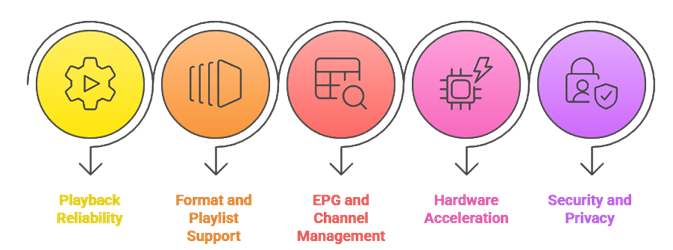
Linux IPTV players differ widely in codec support, playlist handling, and stability across distros and desktops. Our team tested top picks on Ubuntu and Fedora to ensure smooth playback, quick setup, and reliable EPG. These criteria aim to save time and resources, so you get a secure solution that performs consistently across long viewing sessions.
- Playback Reliability: We chose based on crash-free streaming, low latency, and stable deinterlacing during long live sessions.
- Format and Playlist Support: The experts in our team shortlisted tools supporting M3U, Xtream, HLS, MPEG-TS, and DRM-free streams.
- EPG and Channel Management: Our team chose players with accurate XMLTV EPG, fast search, favorites, and quick category filtering.
- Hardware Acceleration: We made sure to shortlist apps using VAAPI or NVDEC, reducing CPU load for 4K playback.
- Security and Privacy: We considered sandboxing, safe URL handling, and update cadence, in order to avoid risky add-ons.
The experts in our team selected players that consistently maintain stable playback and provide versatile IPTV options today.
Are Linux IPTV Players Legal?
When people search for the best Linux IPTV players, one common question comes up. Are these players legal to use? The answer depends on how you use them. The IPTV player itself is just a media tool, similar to VLC or any other video app. It does not host or distribute content on its own. The real concern is the source of the streams you load into it. In my experience, understanding this difference is very important before installing anything. Not all IPTV sources follow the same rules or content rights.
Here are the key points you should know:
- Players Are Legal: Tools like Kodi, VLC, and IPTVnator are legal software. They simply play streams you provide.
- Stream Sources Vary: Some third-party M3U lists may link to copyrighted material without permission. Streaming such content may break copyright laws in many countries.
- Players Do Not Host Content: These apps only render and organize streams. Legal responsibility often depends on the source you use.
- Check Your Local Laws: Streaming laws differ by country. I always advise users to understand their local regulations before adding community playlists.
Choosing trusted and licensed IPTV providers keeps your streaming experience safe and compliant.
Common Issues With Linux IPTV Players & How to Fix Them
Even the best Linux IPTV players can sometimes stop current as expected. IPTV depends on servers, internet speed, and third-party sources. If one part fails, the player may not load streams. Over the years, I have seen that most issues are technical and can be fixed easily. The key is to identify the root cause instead of reinstalling everything at once. A clear approach saves time and avoids frustration.
Here are common problems and practical fixes:
- No Streams Available: This usually happens when the playlist URL is down or expired. Refresh the M3U link or contact your provider for a new one.
- Buffering or Slow Playback: Check your internet speed first. Lower the streaming quality if needed. I also recommend closing background apps and increasing network cache.
- EPG Not Loading: Verify your XMLTV URL is correct and reachable. Channel IDs must also match the playlist entries.
- Codec Errors: Install missing codecs through your distro’s package manager. Most Linux systems require additional libraries for H.265 and certain audio formats.
- App Crashing: Update the player to the latest version. Clearing cache and resetting configuration can also fix minor bugs.
Most issues are temporary. Regular updates and choosing reliable playlists help maintain a stable streaming experience.
Should You Use a VPN With Linux IPTV Players?
When discussing the best Linux IPTV players, many users ask whether a VPN is necessary. The answer depends on how you use these players and which streams you load. The players themselves are legal tools. However, some community playlists pull content from third-party servers. This can raise privacy and security concerns. In my experience, online streaming always involves data sharing with servers. A VPN can add a layer of privacy, but it is not a magic solution. It should be used with clear understanding, not fear.
Here are key points to consider:
- Privacy Protection: A VPN hides your IP address from external servers. This helps protect your browsing activity from being easily tracked.
- Public WiFi Safety: If you stream on public networks, a VPN encrypts your connection and reduces risk.
- Geo Restrictions: Some legal services restrict content by region. A VPN may help access content available in other locations, depending on service policies.
- Legal Responsibility: A VPN does not make illegal streaming legal. I always remind users to follow local copyright laws.
- Speed Impact: Some VPNs slow down streaming. Choose a reliable provider if you decide to use one.
A VPN can improve privacy, but safe streaming starts with choosing trusted and legal IPTV sources.
Verdict:
In this review, you got acquainted with some of the best Linux IPTV players for stable playback and reliable channel management. Each player delivers different strengths, whether it is flexibility, simplicity, or codec support. To help you take the final call, I have created this verdict.
- Kodi: A top-rated and powerful choice when you want a customizable hub with add-ons, library features, and a 10-foot interface for TVs. Its robust PVR client integration and hardware acceleration make it a superior choice for users who value flexibility and a full media-center experience.
- VLC Media Player: A remarkable and cost-effective pick for quick M3U playback and troubleshooting streams. It offers wide protocol support and reliable codec handling, making it an excellent option if you are deciding on a dependable everyday player that just works on any Linux distro.
- IPTVnator: A phenomenal and user-friendly IPTV-focused player with clean playlist management and XMLTV EPG support. With its modern interface, favorites system, and great compatibility with Linux desktops, I recommend it as a top choice for users wanting a dedicated and engaging IPTV workflow.
FAQs
Are Linux IPTV players completely free to use?
Many Linux IPTV players are free and open-source like VLC, Kodi, and IPTVnator, but “free” often means the player only. Some apps have optional paid add-ons, premium skins, or require a subscription IPTV service for content. You may also pay for a VPN or EPG source depending on your setup.
Do Linux IPTV players come with channels and VOD included?
Typically, no. Most Linux IPTV players are just playback tools and do not include channels, VOD, or sports packages. You must add your own legal source, such as an M3U playlist, Xtream API login, or a provider’s portal URL. Avoid “preloaded” channel lists since these are often unauthorized.
Which Linux distributions support these IPTV players?
Top IPTV players run well on major Linux distros including Ubuntu, Debian, Fedora, Arch, Linux Mint, and openSUSE. VLC and Kodi are widely available via official repos or Flatpak and Snap. Lightweight distros can work too, but hardware acceleration and codec support vary by drivers.
Do Linux IPTV players support M3U playlists and Xtream Codes?
Yes, many do. VLC and Kodi reliably support M3U and M3U8 links, while dedicated IPTV apps like IPTVnator, Hypnotix, and some Kodi add-ons can handle EPG via XMLTV and playlist management. Xtream Codes support is less universal, so look for “Xtream API” or “XC” login support in app features before installing.
Is it legal to use IPTV players on Linux?
Using an IPTV player on Linux is legal since the software is just a media player. Legality depends on the content source. Playing official streams or a legitimate paid IPTV subscription is fine. Streaming pirated channels or unverified services can violate copyright laws. Choose licensed providers and keep proof of subscription.
What is the best Linux IPTV player for beginners?
If you are new to IPTV on Linux, VLC is the safest starting point because it is already in most Linux stores and supports many stream types. IPTVnator is also beginner-friendly with a modern interface and clean M3U management. Kodi is great too, but it needs more setup and add-ons before everything runs smoothly.