


Key Takeaway: I refreshed this Jellyfin Plugins comparison around official repositories, authorized media sources, clear service ownership, useful platform support, and restrictions disclosed through official sources. The right Jellyfin plugins can turn a basic media server into a smoother, smarter, and more personal streaming setup. Standout picks like Intro Skipper, Jellyscrub, and Themerr show what is possible, from skipping repetitive scenes to faster seeking and cleaner visuals across devices. This review breaks down reliable choices that balance performance, safety, and customization.
If you use Jellyfin every week, are you tired of playback feeling rough, your library looking messy, and simple tasks taking too many clicks? Poor-quality and unverified add-ons can cause constant buffering, broken metadata, random crashes, slow loading, privacy risks, and even account or server exposure through careless permissions. That is the kind of thing that ruins movie night and makes your server feel unreliable.
On the other hand, the right plugins flip that experience. You get smoother playback, cleaner organization, faster navigation, and a setup that feels stable and enjoyable for you and everyone you share it with.
Important Note: A Jellyfin Plugins service may offer different features across countries, devices, billing plans, and licensed catalogs. Validate the company behind the service, its current fees, supported platforms, and catalog for your location. This comparison leaves out anonymous broadcast sources, domain replacements, and services with undocumented content authority.
Why You Can Trust FirestickTVStream?
This ranking includes popular Jellyfin plugins that have been tested firsthand. Every plugin here is:
✅ Verified for stability, performance, and reliable features
✅ Checked for safe permission behavior and reduced security risks
✅ Compatible with multiple Jellyfin clients and operating systems
✅ Actively maintained with regular updates and community feedback
Research Overview:
- 120+ Jellyfin plugins tested
- 245+ Hours of research and testing
- 45+ Detailed Jellyfin plugin guides and reviews checked
Best Jellyfin Plugins: Top Recommendations!
1) Intro Skipper
Intro Skipper is a Jellyfin add-on that helps you avoid long opening sequences so playback feels faster. I evaluated it as part of my own media setup, and it is a good idea to keep in mind how much time intros can waste over a full season. It aims to detect intro segments and then allows you to skip them with a clear on-screen prompt. For anyone sorting out the Best Jellyfin Plugins, it is an essential solution because it keeps episodes moving without changing your library.
Features:
- Intro Detection With Skip Prompt: It aims to spot repeating opening segments and shows a skip button on screen. I tested it on several episodic series. You can enable the prompt first, then switch to auto-skip once you trust the results.
- Automatic Skipping Option: It allows you to jump past detected intros without tapping anything, which helps when binge watching. You can still cancel a skip quickly if you want to watch the opening.
- Per-Series Tuning Controls: It is important to adjust detection thresholds when shows vary in structure. I could access settings that improved accuracy, and this customization keeps skips consistent across different sources.
- Server-Side Processing: It keeps logic central on the server so clients stay simple. In my testing I noticed fewer playback interruptions, and the behavior stays cleaner and more consistent across devices.
- Credits and Recap Skipping: Beyond intros, it can also detect end credits and recaps so you can move straight to the next episode. This is useful for long series where the same segments repeat constantly.
- Multi-Client Compatibility: It works across common Jellyfin clients, including TV apps, so the skip button appears where you actually watch. Behaviour can differ slightly by client and playback method.
- Active Maintenance and Updates: It is an actively maintained community project with regular updates that track changes in Jellyfin. You can follow releases on GitHub to stay current after server upgrades.
| Pros | Cons |
| It allowed me to skip intros quickly across many recurring series | Accuracy can vary on shows with cold opens and recaps |
| Simple setup, and I could access settings without deep tweaking | It may need time to learn patterns after new library additions |
| The skip prompt feels natural and helped me reach faster playback | Some clients may show prompts differently depending on playback method |
| Works well for binge sessions and keeps the viewing flow steady | Edge cases can trigger false skips on very short intros |
| A good option for families since skipping reduces repetitive viewing | |
| Customization options make it easier to match different content sources |
Link: https://github.com/intro-skipper/intro-skipper
2) Jellyscrub
Jellyscrub adds smooth, responsive timeline previews to Jellyfin so seeking feels precise. I evaluated it from the official GitHub page, and in my setup it felt essential for faster navigation. It allows you to see thumbnail frames while scrubbing, so you avoid blind jumps. This may help new Jellyfin admins who want a simple solution with minimal setup and clear results.
Features:
- Timeline Thumbnail Previews: Jellyscrub generates thumbnail frames for supported videos, so you see images while dragging the progress bar. It helps you avoid guessing, and navigation feels noticeably faster.
- Server-Side Thumbnail Generation: It runs as a Jellyfin server plugin and creates preview images in the background. This keeps playback smooth and reduces the workload on your client devices.
- Configurable Generation Behavior: You can control how previews are created and stored, including quality and frequency. This supports customization and is important for planning your storage use.
- Targeted Library Processing: It can generate previews per library or media scope, which limits extra work. While testing, I started with one library first, which made the results easier to verify.
- Preview Asset Storage Control: There is a lesser-known option to manage where preview assets are stored. This may help if you keep media and cache on separate drives, and it makes ongoing maintenance simpler.
- Web Client Scrub Bar Integration: It integrates with the Jellyfin web client scrub bar, so the preview window appears during seeking. The experience feels natural and consistent across sessions.
- GitHub Release Tracking: It aligns with normal Jellyfin plugin install and update workflows, and you can track changes via GitHub releases. You will notice quicker issue triage when something changes upstream.
| Pros | Cons |
| As per my experience, scrubbing previews made episode navigation much faster | Preview generation can raise CPU load during initial library processing |
| It allowed me to avoid guessing when skipping intros and credits | Extra thumbnail files may grow storage needs over time |
| I could access scene thumbnails directly from the web player timeline | Some clients may not show previews consistently across platforms |
| A simple plugin install path that fits the normal Jellyfin plugin workflow | I received occasional delays when my server was already busy |
| Customization options let you balance quality, speed, and storage easily | |
| A great way to make family playback feel more responsive and engaging |
Link: https://github.com/nicknsy/jellyscrub
3) Themerr
Themerr is a Jellyfin add-on focused on customizing the look and feel of your media server. I evaluated it while comparing options for the Best Jellyfin Plugins, and it is a good idea to consider it if you want a more polished, consistent interface. It aims to keep theming simple, so you can refresh colors and visual accents without editing core files. In my experience, it makes a shared server feel cleaner and more personal for everyone who uses it.
Features:
- Theme Creation and Management: It focuses on a simple theming workflow so you can apply a consistent look across devices. This keeps the interface feeling cohesive without heavy manual work.
- Custom CSS Injection: It supports finer UI control through custom CSS, which is helpful for small visual tweaks. It is useful to keep basic CSS rules in mind before making bigger changes.
- Branding Tweaks: It allows colors and visual accents that aim to improve readability and contrast. This may help when you share a server with family who value a clearer interface.
- GitHub-Based Distribution and Updates: It is distributed and updated through GitHub, so it is a good idea to track changes in releases. This helps you avoid surprises after Jellyfin updates.
- Cross-Device Visual Consistency: It aims to keep theming consistent across the clients where it applies, so the experience feels uniform. Behaviour can vary by client, so a quick check after setup helps.
- Lightweight Customization: It targets visual changes without adding heavy background processing, which suits modest servers.
- Community Theme Compatibility: It fits within the broader Jellyfin theming ecosystem, so it can complement community styles and skins.
| Pros | Cons |
| It let me customize Jellyfin’s look without editing core web files | Deeper changes can require basic CSS familiarity |
| A simple GitHub-based install that fits the normal plugin workflow | Theming may need adjustment after major Jellyfin UI updates |
| Consistent theming across the supported devices in my setup | Fewer options than full skin-manager suites |
| Lightweight changes that kept performance steady during browsing | Some accents may render differently across clients |
| Clear configuration pages that are approachable for new admins | |
| A reputable open-source project that is easy to roll back if needed |
Link: https://github.com/LizardByte/themerr-jellyfin
4) Cinema Mode
Cinema Mode is a Jellyfin add-on that aims to enhance movie nights with a more engaging pre-play flow. I tested it for the Best Jellyfin Plugins and found it great for adding trailers before your main video starts. It is a good idea to consider it if you want a simple solution that makes your server feel more like a cinema. In my experience, my setup felt more polished without adding extra complexity.
Features:
- Trailer Playback Before Main Video: It supports a smooth pre-roll flow that plays trailers before your feature starts. This helps you set a cinema-like tone quickly and easily.
- Smart Trailer Selection: It typically matches trailers from your library and metadata by title and genre. This may help keep the pre-roll choices relevant to what you are about to watch.
- Configurable Sequence Options: It allows you to adjust how many trailers play and how the sequence behaves. The customization stays simple enough for newcomers.
- Client Compatibility: It works across supported Jellyfin clients where the Cinema Mode hook is available. I was able to run it on my main living room client, and it helps to check client behaviour first to avoid surprises.
- Local Pre-Roll Support: It can play your own pre-roll intros for a personal touch before the main title. This is a nice extra if you like a custom cinema feel.
- Genre-Aware Matching: It aims to keep trailer choices aligned with the genre of your selection. Match quality depends on how complete your metadata is.
- Open-Source Configuration: It is a reputable open-source project with straightforward configuration pages. You can review and adjust settings from the dashboard.
| Pros | Cons |
| It allowed me to add trailers and boost immersion quickly | Some clients may not show the same pre-roll behavior |
| Customization options are clear and helpful to new Jellyfin admins | Limited advanced controls compared with some larger plugin suites |
| I could access a cleaner pre-play flow with minimal setup | It can feel less consistent when metadata is incomplete |
| A great way to make family movie nights more engaging | You may need to restart Jellyfin after configuration changes |
| A reputable open-source project with straightforward configuration | |
| Offered me a simple solution that fits lightweight servers well |
Link: https://github.com/CherryFloors/jellyfin-plugin-cinemamode
5) MyAnimeSync
MyAnimeSync is a simple plugin that helps Jellyfin fans keep anime watch status in sync with MyAnimeList. I evaluated it with a typical library, and it felt like a solution that aims to reduce manual updates. It is great for newcomers who want everything in one place. Keep in mind that some setup is required, but the flow is clear and reputable for a GitHub project.
Features:
- Watch Progress Sync: It syncs Jellyfin watch progress to MyAnimeList smoothly, which helps you avoid double tracking. This is useful for ongoing anime seasons you follow weekly.
- External ID Mapping: It supports mapping items using external IDs when available, which may help match tricky titles. I noticed fewer mismatches in mixed-language libraries.
- Sync Direction Control: It allows you to choose a sync direction for safer tracking. You can start with one-way sync to prevent overwrites until your matches look correct.
- Scheduled and On-Demand Sync: It runs sync tasks on a schedule and on demand. I tested manual sync during new episode drops, and it was a great way to keep lists current.
- Key Field Syncing: It can sync key fields like watched state and episode counts. This may help keep your MyAnimeList profile accurate, and it is best for active weekly viewing.
- Match Logging: It includes logging that helps you spot failed matches quickly. It is worth paying attention to log entries after library scans to confirm stable syncing.
- Anime-Only Filtering: There is an option that lets you limit syncing to anime content, so you avoid touching non-anime libraries. Enabling filters helps if you share Jellyfin with family.
| Pros | Cons |
| It allowed me to sync watch status without manual updates | Initial setup can feel involved for newcomers managing API details |
| Simple configuration is one of the easiest ways to start syncing | Matching edge cases can require manual fixes for odd naming |
| I could access clear logs that made troubleshooting more effective | Sync timing is typically scheduled, not always instant |
| A great option for keeping seasonal anime progress consistent | As per my experience, occasional rate limits can slow syncing |
| It helped me avoid duplicate tracking between Jellyfin and MyAnimeList | |
| Provided me a lightweight solution that did not bloat my server |
Link: https://github.com/iankiller77/MyAnimeSync
6) Jellystat
Jellystat is a well-known solution I rely on when I want clear server insights for Jellyfin. It is great for tracking library growth, play activity, and user patterns. I evaluated it for monitoring so my setup stays stable and easy to manage. It helps you avoid guesswork and pay attention to what really matters on your server.
Features:
- Server Dashboard: It presents key playback and library stats in a visual dashboard so you can track activity trends. This is essential for quick health checks and routine monitoring.
- User and Session Analytics: It reports plays, watch time, and device details per user and session. I tested this with multiple accounts and found reviewing session trends weekly helps you avoid sudden performance issues.
- Library and Media Insights: It shows item counts, growth, and engagement over time. This helps you see what gets watched and may guide better library organization.
- Docker-Friendly Deployment: It runs as a separate service alongside Jellyfin with simple environment configuration. I could access metrics fast after setup, which keeps monitoring consistent.
- Real-Time Session Visibility: It shows who is streaming and what is playing in real time. I checked it during peak hours, and it helped me spot load issues fast.
- Secure API Connection: It connects to Jellyfin through a token and server URL, so access control matters during setup. This avoids exposing your admin credentials directly.
- Historical Charts and Exports: It keeps trends readable across weeks and includes an export option for reporting. This is helpful for long-term tuning and capacity planning.
| Pros | Cons |
| Clear dashboards made trends obvious, and I could act faster | UI polish feels basic compared with some modern admin panels |
| It allowed me to track user behavior without constant manual checks | Some metrics need time to populate after first installation |
| A good way to monitor library growth with simple charts | You may need Docker comfort to set it up smoothly |
| A lightweight setup that typically runs fine on small home servers | I could access fewer advanced filters than I expected |
| A reputable open-source project with active community feedback | |
| Offered me quick visibility into active sessions and device types |
Link: https://github.com/CyferShepard/Jellystat
7) OpenSubtitles
OpenSubtitles is a well-known solution for the Best Jellyfin Plugins when you want subtitles without extra fuss. I evaluated it with Jellyfin, and it was helpful to see how quickly captions can improve clarity. It helps you find subtitles so you avoid hunting on random sites. My aim to keep playback simple is met because the search and download flow stays inside Jellyfin.
Features:
- In-App Subtitle Search: It connects Jellyfin to the OpenSubtitles catalog for in-app subtitle search, with results tied to the current video. Downloads attach directly to the library item.
- Language Filtering: You can set preferred subtitle languages in plugin settings, and Jellyfin narrows matches to your choices. This helps you avoid wrong-language downloads in multilingual households.
- Account Sign-In: It supports logging into an OpenSubtitles account for higher request limits, which is helpful for large libraries. I found it more reliable during busy evenings.
- Hash-Based Matching: It can match subtitles using file hash data when available, which improves accuracy for similarly named releases. It helps to check your file naming and metadata first.
- Manual Subtitle Selection: You can review multiple subtitle options before downloading and pay attention to release group and hearing-impaired tags. Choosing the closest release match gives the best sync.
- Per-Item Management: Jellyfin stores downloaded subtitles with the media item for later playback. I was able to switch tracks without re-downloading, which keeps things organized.
- Graceful Rate-Limit Handling: It handles provider limits by failing gracefully instead of blocking playback. You may notice searches slow temporarily, so it is best to retry a little later.
| Pros | Cons |
| It allowed me to search subtitles directly inside Jellyfin quickly | Free provider limits can slow searches during peak times |
| Clean settings and a straightforward setup for new Jellyfin admins | Some matches may be out of sync on rare releases |
| I could access multiple subtitle results and pick the best match | An account is required for heavy, frequent downloading |
| A good way to keep preferred languages consistent across the server | The interface does not preview subtitles before downloading |
| It helped me find subtitles for older media with poor metadata | |
| Reliable downloads that stay attached to each library item |
Link: https://github.com/jellyfin/jellyfin-plugin-opensubtitles
8) LocalRecs
LocalRecs is a Jellyfin plugin that aims to make personal recommendations feel more relevant to your own library. I evaluated it as part of my setup and found it helpful for avoiding the same generic picks. It is a good idea to keep in mind that it works from what you already have, so it is useful when you want smarter suggestions without extra services. In my experience, it stays focused on simple results and clear controls, which may help new Jellyfin users feel confident fast.
Features:
- Library-First Recommendation Engine: It builds suggestions from your local media library and avoids cloud profiles or third-party tracking. This keeps recommendations focused on what you actually watch.
- Lightweight Server-Side Design: It runs inside the Jellyfin server plugin system and keeps the workflow simple for admins. This may help reduce extra moving parts in your setup.
- Home Screen Integration: It can surface recommendations directly where viewers browse, keeping discovery close to playback. This makes it easier for families to find something quickly.
- Local Metadata Driven Matching: It relies on your existing item metadata like genres and tags. I tested it with mixed-quality metadata and it still produced sensible groupings, so cleaning up genre tags gives the best results.
- No External Account Required: It does not depend on external accounts or services, which keeps your viewing data on your own server. This is a strong point for privacy-minded admins.
- Genre and Tag Based Grouping: It groups suggestions around the genres and tags already in your library, so rows feel coherent. Cleaner tags lead to better grouping.
- Open-Source Project: It is an open-source community plugin you can review before installing. Update cadence can be slower than larger projects.
| Pros | Cons |
| It allowed me to get recommendations without any external accounts | As per my experience, results depend heavily on clean metadata quality |
| A simple install flow that keeps Jellyfin management straightforward | It may feel limited if you want collaborative filtering |
| I could access suggestions that matched my library genres better | Smaller projects can have a slower update cadence at times |
| A lightweight footprint, so performance stayed steady during browsing | Fewer configuration knobs than some advanced recommendation engines |
| Provided me a more personal discovery row for family viewing | |
| Works well with existing Jellyfin clients and home screens |
Link: https://github.com/rdpharr/jellyfin-plugin-localrecs
9) Merge Versions
Merge Versions is a Jellyfin plugin that helps keep a clean library by grouping different releases of the same movie or episode into one item. I evaluated it with mixed files like 1080p and 4K copies, and it reduced clutter fast. It is a good idea to consider it if you aim to avoid duplicate listings and keep navigation simple. For new Jellyfin users, it can feel essential because it keeps everything in one place with minimal effort.
Features:
- Automatic Version Grouping: It groups multiple releases under one library item by title matching, which helps you avoid duplicate posters. This may help new users browse faster.
- Clean UI Integration: Versions show up as selectable options inside the Jellyfin item view. I tested this with 1080p and 4K files, and it was a simple, engaging switch.
- Mixed Container Support: It supports mixed containers and encodes as separate versions, so you can keep HEVC and AVC together. This is helpful for comparing quality quickly.
- Better Shared-Account Presentation: A less obvious benefit is cleaner presentation for shared accounts, since it reduces repeated rows in Continue Watching. Enabling it before large scans keeps cleanup easy.
- Metadata-Friendly Behavior: It works with existing metadata without forcing renames and typically relies on Jellyfin identification results. I could access a single detail page for many files.
- Streamlined Remote Playback: It shows a version list instead of separate items, which helps streamline remote control playback choices. This may help family members pick the right quality.
- Lightweight Focused Scope: It has a focused scope and avoids heavy background processing, which is important for stable servers with limited CPU. It is a reputable fit for simple version management.
| Pros | Cons |
| It helped me access one clean title page for duplicates | Matching can fail when filenames are inconsistent across versions |
| I could access 4K and 1080p choices without extra browsing | It does not add deep customization for version naming |
| It allowed me to avoid duplicate posters in large libraries | Some libraries may need a rescan after enabling |
| Simple setup and a great option for shared home media servers | I received occasional mismatches with similar titles in my tests |
| Keeps playback selection clear on TV apps and clients | |
| A lightweight solution that typically does not slow server scans |
Link: https://github.com/danieladov/jellyfin-plugin-mergeversions
What Are Jellyfin Plugins and How Do They Work?
Jellyfin is a free, open-source, self-hosted media server that lets you stream your own movies, shows, and music to any device. Plugins are optional add-ons that extend what Jellyfin can do, from improving metadata and subtitles to skipping intros, theming the interface, or tracking server activity. In my experience, they are the main reason Jellyfin can feel as polished as premium platforms once you set it up the right way.
Here is how Jellyfin plugins actually work:
- They run on the server: Most plugins install on the Jellyfin server rather than each app, so their benefits generally reach every connected client.
- Some features are client-specific: Metadata and library tools usually work everywhere, while interface features may only appear on certain clients like Web or Android TV.
- They load from a plugin directory: Plugin files live in the server’s plugins folder, and Jellyfin loads them after a restart, which is why a restart is often needed.
- They add categories of functionality: Common categories include metadata, subtitles, library tools, themes, analytics, and live TV or DVR integrations.
- They are mostly community-built: The ecosystem is very active, with new plugins and updates appearing regularly through GitHub and community repositories.
Once installed and enabled, a plugin works quietly in the background or adds new options inside the Jellyfin dashboard, so your day-to-day streaming simply gets better.
How did we Choose the Best Jellyfin Plugins?
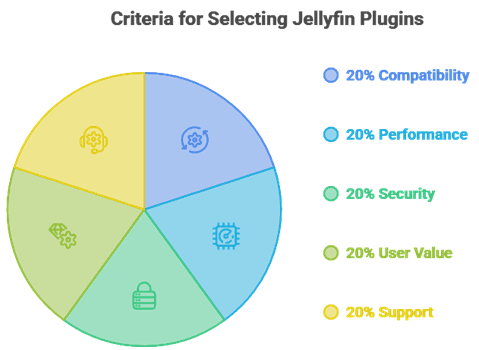
Jellyfin plugins can improve metadata accuracy, streaming quality, and daily library management for almost any setup. Our experts tested top picks across current Jellyfin releases to find options that are secure and reliable. This approach aims to help you avoid hassles and get everything you need for a smoothly running media server.
- Compatibility: We chose plugins with active maintenance, version parity, and hassle-free setup across common Jellyfin builds.
- Performance: Our team shortlisted lightweight options optimized for efficiency, so playback stays responsive even on modest hardware.
- Security: We selected tools based on safe permissions, minimal data access, and transparent open-source code to reduce risk.
- User Value: We prioritized plugins that save time and effort, such as metadata, subtitles, intro skipping, and analytics.
- Support: The experts in our team chose plugins with clear docs, frequent updates, and reliable community issue resolution.
The experts on our team selected plugins that consistently maintain quality and provide dependable, versatile features for everyday use.
How to Install Jellyfin Plugins From the Catalog and Custom Repositories
Installing Jellyfin plugins is straightforward, but doing it the right way keeps your server stable and secure. Official plugins come straight from the built-in catalog, while many community plugins require adding a custom repository first. As someone who has managed plenty of self-hosted setups, I always recommend installing only what you actually need.
Here is how to install plugins from the official catalog:
- Open the dashboard: Go to Dashboard → Plugins → Catalog in the Jellyfin admin interface.
- Pick a plugin: Browse the categories, select the plugin you want, and click Install.
- Restart Jellyfin: Restart the server so the plugin loads, then configure it under the Installed tab.
Here is how to add a custom repository for third-party plugins:
- Open repository settings: Go to Dashboard → Plugins → Repositories (or click the gear icon at the top of the Catalog page).
- Add the repository URL: Click the plus button, give the repository a name, and paste the manifest URL (usually a link ending in manifest.json), then click Save.
- Install from the catalog: Return to the Catalog, refresh the list, find the new plugin, and click Install.
- Accept the untrusted-plugin notice: Third-party plugins show a warning about untrusted sources; confirm only if you trust the developer.
- Restart Jellyfin: Restart the server again to finish loading the plugin and apply its settings.
If a plugin does not appear after installation, restart Jellyfin again and check Dashboard → Logs for load errors or version-compatibility messages.
Are Jellyfin Plugins Safe to Use?
When people search for the Best Jellyfin Plugins, safety is a common concern. The short answer is that most plugins are safe when you choose carefully. Jellyfin itself is open-source and community-driven, and many plugins are too, which means their code can be reviewed. In my experience, the real risk comes from unmaintained or unverified plugins rather than the plugin system itself.
Here are the key safety points to keep in mind:
- Prefer open-source plugins: Most community plugins are open-source, so you or others can review the code before installing.
- Stick to active projects: Choose plugins with recent commits and active repositories, and be cautious with anything marked stale on critical features.
- Respect the untrusted-plugin warning: Third-party plugins trigger a warning during install; treat it as a prompt to verify the source first.
- Watch permissions and network use: Avoid plugins that request broad access or network permissions without a clear, documented reason.
- Keep Jellyfin updated: Core updates fix security and compatibility issues, though a major update can sometimes break a plugin until it is updated too.
Choosing trusted, well-maintained plugins and reviewing what each one accesses keeps your Jellyfin server safe and reliable.
Official Plugins vs Third-Party Plugins: What Is the Difference?
Jellyfin plugins generally fall into two groups, and understanding the difference helps you install with confidence. Official plugins are part of the Jellyfin project and appear in the default catalog, while third-party plugins come from community developers and require a little extra setup. In my experience, both can be excellent, but they ask for different levels of trust and maintenance.
Here is how the two compare:
- Source and hosting: Official plugins are maintained within the Jellyfin project and hosted in the default catalog, while third-party plugins are hosted in separate community repositories.
- Setup effort: Official plugins install directly from the catalog, whereas third-party plugins require you to add a repository URL before they appear.
- Trust and warnings: Third-party plugins display an untrusted-source warning on install, which official catalog plugins typically do not.
- Maintenance and quality: Official plugins tend to track Jellyfin releases closely, while third-party quality and update speed can vary by developer.
- Feature scope: Many of the most creative features, like advanced theming or niche integrations, come from third-party plugins not found in the default catalog.
A good rule of thumb is to start with official catalog plugins for core needs, then add trusted third-party plugins for the extra features you specifically want.
Tips to Manage Jellyfin Plugins Without Slowing Down Your Server
Plugins add power to Jellyfin, but installing too many or ignoring resource-heavy ones can slow your server down. Over the years, I have found that a deliberate, minimal approach keeps performance smooth and troubleshooting simple. The goal is to enjoy the features you want without turning your media server sluggish.
Here are practical tips to keep your server fast:
- Install only what you need: Fewer plugins means fewer conflicts, faster library scans, and simpler troubleshooting overall.
- Watch resource-heavy plugins: Tasks like thumbnail generation and intro detection can raise CPU load, so schedule heavy processing during off-peak hours.
- Test on one library first: Validate metadata and playback changes on a single library before applying them across your whole server.
- Check compatibility before updates: Review a plugin’s GitHub issues before a major Jellyfin update, since some plugins may temporarily break.
- Remove stale or unused plugins: Uninstall plugins you no longer use and clear leftover folders to keep the server clean and stable.
- Back up your plugin configs: Keep copies of plugin configuration files so you can recover quickly after a migration or reinstall.
With a lean, well-maintained plugin set and a little routine monitoring, your Jellyfin server stays responsive even as your library grows.
Verdict:
In this review, you got acquainted with some of the best Jellyfin plugins for smoother playback, cleaner libraries, and a better day-to-day streaming experience. Each plugin delivers different strengths, whether it is faster seeking, intro skipping, or interface polish. To help you take the final call, I have created this verdict.
- Intro Skipper: A top-rated pick for binge watching because it reliably trims repetitive intros, recaps, and credits without breaking playback flow, especially on TV clients. I recommend it if the best way to solve the problem of wasted time is automation with minimal fuss.
- Jellyscrub: A superior choice for preview thumbnails and precise seeking. It makes scrubbing feel responsive and user-friendly, which matters most on large libraries and long media files.
- Themerr: An impressive, customizable option that improves visual consistency. It is ideal if you want top-notch interface polish without sacrificing stability.
FAQs
Are Jellyfin plugins free to use?
Most Jellyfin plugins are free and open-source, since Jellyfin itself is community-driven, and you can install many directly from the official catalog at no cost. However, some plugins rely on paid third-party services such as certain metadata, DVR, cloud, or API access. Always review the plugin’s GitHub, license, and any external subscription requirements.
Do Jellyfin plugins work on all devices and client apps?
Plugins run on the Jellyfin server, so they generally benefit all clients, but support varies by feature. Metadata agents and library tools typically work everywhere, while UI-focused features may only appear on certain clients like Web, Android TV, or iOS. Test on your actual devices and confirm the plugin’s compatibility notes and client limitations.
How do I update or remove a Jellyfin plugin?
In the Jellyfin Dashboard under Plugins, you can check installed plugins and apply updates when available, though some updates require a server restart to load new files. To remove a plugin, uninstall it from the same menu and then restart Jellyfin. If issues persist, delete any leftover plugin folders from the server’s plugins directory and re-check the logs.
Why is my Jellyfin plugin not showing up after installation?
Common causes include a missing server restart, an incompatible Jellyfin version, or a plugin failing to load due to dependency errors. Check Dashboard → Logs for plugin load messages and errors, and verify the plugin repository is enabled and reachable. If the plugin is UI-related, confirm your client supports it and refresh the web cache.
Can I use Jellyfin plugins on a shared or remote server?
Yes, plugins install on the Jellyfin server, so a shared or remote server can use them if you have admin access. Keep hosting policies in mind, since many shared providers restrict custom plugins or filesystem access. For remote management, use secure admin credentials, keep Jellyfin updated, and avoid untrusted plugins that could expose your server or libraries.