
Key Takeaway: The current Chromecast Alternatives guide favors official applications, format compatibility, recognized publishers, dependable device documentation, and transparent access conditions. If your Chromecast no longer fits your setup, there are stronger streaming devices worth a serious look. Popular picks like Google TV Streamer 4K, Amazon Fire TV Stick 4K Max, and Roku Streaming Stick 4K often lead the conversation, but not every device is right for every home. This review breaks down reliable options that balance performance, casting support, and long-term updates for smoother streaming.
Are you tired of your stream cutting out right when the good part starts, or your device acting like it has a mind of its own? That frustration usually comes from low-quality, unverified streaming tools. They can trigger constant buffering, blurry or unstable video, random app crashes, weak Wi-Fi performance, intrusive ads and pop-ups, and even privacy risks from shady tracking. Some also stop getting updates, so apps break over time and support disappears.
The right device fixes most of this with faster streaming, cleaner navigation, and more reliable playback. When you choose wisely, watching becomes effortless, enjoyable, and stress-free again.
Important Note: Regional catalogs, device requirements, subscription rules, and operator permissions can affect each Chromecast Alternatives recommendation. Verify the official publisher, price, supported hardware, and relevant catalog before creating an account or paying. This page omits copied channel sources, changing mirror sites, and providers that do not publish accountable rights details.
Why You Can Trust FirestickTVStream?
This ranking includes popular Chromecast alternatives that have been tested firsthand. Every device here is:
✅ Compatible with popular TV brands and major streaming apps
✅ Strong enough for smooth 4K streaming, IPTV playback, and stable Wi-Fi performance
✅ Backed by ongoing updates, active user communities, and reliable brand support
Research Overview:
- 40+ Streaming devices tested
- 255+ Hours of research and testing
- 55+ Detailed streaming device guides and reviews checked
Best Chromecast Alternatives: Top Recommendations!
1) Google TV Streamer 4K
Google TV Streamer 4K is a reputable solution when you want a simple Chromecast alternative for modern streaming. I tested it for quick setup and smooth day-to-day control. It is great for 4K playback and a clean home screen. It also helps you keep track of what to watch next across popular apps with less switching.
Features:
- Fast Setup and Account Sync: Setup guides you through Wi-Fi and Google sign-in. It helps you avoid long configuration. I tested it on a new television and finished quickly.
- 4K Playback With HDR Support: Video outputs at up to 4K on supported displays. HDR improves color and contrast. It is best to pair it with a capable HDMI port.
- Google TV Recommendations Across Apps: The home screen shows watchlist items and suggested shows. It helps you keep track of what you started. Navigation feels consistent and clean.
- Voice Search and Assistant Controls: The remote supports voice search for titles and genres. It allows you to open apps faster. I noticed responses stayed accurate during evening viewing.
- Multi-User Profiles and Kids Controls: Profiles keep recommendations separate for each person. Kids profiles limit content and app access. It is a good idea to set bedtime limits.
- Smart Home Quick Panel: A control panel shows compatible devices on screen. It allows you to check cameras and lights fast. I recommend pinning key devices for faster access.
- Bluetooth and Accessory Support: It pairs with Bluetooth headphones and some controllers. Audio stays private for late viewing. This may help when you share a room.
| Pros | Cons |
| It helped me access clear 4K menus and smoother navigation | Amazon listings make long term firmware support details harder to confirm |
| Reputable Google TV layout keeps recommendations easy for beginners | Some apps still show ads, which can feel distracting |
| I could access voice search quickly from the remote button | Storage is limited, so heavy app installs may require pruning |
| Smart home panel is great for quick camera checks | Ethernet may need an adapter, depending on your setup |
| It allowed me to switch profiles fast for family viewing | |
| Solid Bluetooth audio pairing for late night watching |
Link: https://www.amazon.com/Google-Streamer-Streaming-Entertainment-Porcelain/dp/B0D8WJYSF9
2) Amazon Fire TV Stick 4K Max
Amazon Fire TV Stick 4K Max is a great option if you want a simple, reliable Chromecast alternative. I evaluated it for everyday streaming on a 4K TV. It allows you to start fast and keep apps in one place. I find it helpful to consider if you want smooth 4K playback, strong Wi-Fi, and a familiar remote.
Features:
- Connectivity and Casting Options: It supports Miracast for screen sharing from many Android devices. That helps if you miss classic casting. Setup is guided and typically quick.
- Voice Remote and TV Controls: The remote has Alexa voice search and app buttons. It can control TV power and volume. I suggest pairing it early to avoid extra remote juggling.
- Live TV and Channel Integration: It aggregates live sources and app channels in one guide. This may help reduce app hopping. Personalization improves after a few days of viewing.
- Home Theater Audio Pairing: It can pair with compatible Echo speakers for wireless home theater audio. I noticed clearer dialog in a small room setup. It is a good idea to check Echo model support first.
- Storage Expansion via USB: Some bundles support a USB cable that allows Ethernet and storage. That is a lesser-known perk for power users. It helps you add space for more apps.
- Smart Home Dashboard: The Fire TV dashboard can show cameras and smart devices. It is helpful to check a doorbell feed mid-movie. It keeps controls close to the couch.
- Profile and Kids Controls: Multiple profiles and Kids settings manage recommendations and limits. It is important for shared TVs. I was able to set bedtime limits without fuss.
| Pros | Cons |
| It allowed me to get smooth 4K streaming with Dolby Vision | Home screen has promos, and it can feel busy |
| Wi-Fi 6E support reduced buffering on my crowded network | Some apps may require extra sign-ins during first setup |
| Voice search offered me fast results across many streaming apps | I could access fewer casting-first apps than Chromecast sometimes |
| Remote controls TV power and volume, which is essential daily | Storage is limited unless you add compatible USB accessories |
| Ambient Experience makes idle TV screens more engaging and useful | |
| Live guide view is helpful to avoid constant app switching |
Link: https://www.amazon.com/Amazon-Stick-Power-eliminates-adapter/dp/B0CBQGLR64/
3) Roku Streaming Stick 4K
Roku Streaming Stick 4K is a great option if you want a simple, reliable solution beyond Chromecast. I evaluated it for everyday streaming and quick setup on modern televisions. It is essential for people who want fast access to major apps without extra steps. My view is that it helps you avoid phone dependency while still keeping controls easy and clear.
Features:
- Fast 4K Streaming With Dolby Vision: It supports HDR10 and HDR10 plus on compatible televisions. Picture quality stays high on strong connections. This is essential for premium streaming at a fair cost.
- Stronger Wi-Fi for Harder Rooms: It includes a long-range wireless receiver. I tested it far from my router and playback stayed stable. It might be helpful to avoid constant buffering.
- Simple Setup on Any HDMI Television: Plug it in and follow the on-screen steps. The interface is one of the easiest for beginners. It helps you start watching in minutes.
- Voice Remote With TV Controls: The remote can manage TV power and volume. Voice search helps you find shows across apps. I recommend enabling private listening for late-night viewing.
- Broad App Support With Roku Search: It covers most popular streaming apps in one place. Roku Search compares options across services. This may help you pick the best way to watch.
- Private Listening and Headphone Modes: You can listen through the mobile app or some remotes. While using this feature, one thing I noticed was low audio delay. It is great for quiet homes.
- Guest Mode for Travel: Guest Mode signs you out automatically on a chosen date. It keeps accounts safer in hotels or rentals. I suggest turning it on before trips to avoid leaving logins behind.
| Pros | Cons |
| Smooth 4K Dolby Vision playback, and I could access settings quickly | No native casting focus, so phone-first control feels limited |
| Long-range Wi-Fi kept streams stable, even in my back room | Amazon listings vary, so bundle details may be confusing |
| Voice Remote offered me fast searches across apps without typing | Some apps show extra promos, which can distract new viewers |
| Guest Mode helped me avoid leaving accounts signed in while traveling | Limited advanced audio controls compared with some high-end boxes |
| Simple interface is one of the easiest for beginners to learn | |
| Portable stick fits behind televisions and reduces cable clutter |
Link: https://www.amazon.com/Roku-Streaming-Device-Vision-Controls/dp/B09BKCDXZC?th=1
4) Apple TV 4K
Apple TV 4K is a well-known streaming box that I consider a great option if you want a Chromecast-style setup with a simple remote and a polished interface. It aims to make TV streaming easier with smooth performance and high-quality picture and sound.
I reviewed it for everyday living-room viewing, and it may help you avoid messy phone casting when you just want content to start fast. For beginners, it is important to know that it works best inside the Apple ecosystem, yet it still supports many major streaming apps with solid customization.
Features:
- Streaming App Support: It covers most major streaming services. Logins sync quickly across devices. It reduces reliance on phone casting for daily viewing.
- AirPlay Casting and Mirroring: AirPlay sends video, photos, and screen mirroring. I tested mirroring from my iPhone and it stayed responsive. I recommend AirPlay for quick sharing with guests.
- Siri Remote Control and Voice Search: The Siri Remote allows precise scrubbing and simple navigation. Voice search finds shows across many apps. It may help you avoid typing with on-screen keyboards.
- Apple Ecosystem Pairing and Setup: iPhone-based setup speeds sign-in and Wi-Fi connection. It also supports Home app integration. I was able to switch audio to AirPods quickly.
- Home Hub and Smart Home Control: It can act as a home hub for HomeKit automations. You can view camera feeds on television. It is helpful to keep smart controls in one place.
- Multi-User Profiles and Up Next: Profiles keep watchlists and recommendations separate. Up Next queues episodes across supported apps. It helps you continue playback without hunting through menus.
- Color Balance Calibration via iPhone: A lesser-known tool calibrates color using your iPhone camera. It adjusts output to match your television. I suggest running it after changing picture modes.
| Pros | Cons |
| Fast menus and smooth playback, I could access apps instantly | Works best with Apple devices, Android casting feels limited |
| AirPlay mirroring worked reliably, it allowed me to share photos | Fewer budget models available compared with common streaming sticks |
| High-quality 4K HDR and Dolby Vision on compatible televisions | Some apps still show ads unless you pay separately |
| Siri voice search felt helpful, I received accurate cross-app results | I could not access full web browsing without extra workarounds |
| Strong privacy controls and reputable tvOS updates over time | |
| Solid customization for the Home screen and multi-user profiles |
Link: https://www.amazon.com/2021-Apple-TV-64GB-Renewed/dp/B096HRD9WP/?th=1
5) NVIDIA Shield TV Pro
NVIDIA Shield TV Pro fits well for anyone comparing Chromecast alternatives and wanting a dependable streaming box that does more than casting. I checked it as a solid solution for TV streaming, local playback, and smart home control. It is a good idea to consider its high performance, since it helps you avoid lag on busy networks. For my living room setup, it felt essential, and one of the easiest ways to get smooth 4K HDR with strong app support.
Features:
- AI Upscaling for Sharper Video: It upscales HD video to near-4K on supported content. Text and edges look cleaner. I noticed it helps you avoid a soft picture on large TVs.
- Built-In Chromecast 4K Casting: It supports Chromecast built-in for casting from phones and laptops. Setup is typically quick on Wi-Fi. It is a great way to share clips and photos.
- Dolby Vision and Dolby Atmos Support: It plays Dolby Vision on compatible streaming apps and titles. Dolby Atmos works with supported soundbars and receivers. This may help if you want a cinematic setup.
- Gigabit Ethernet and Strong Wi-Fi: It includes Gigabit Ethernet for stable streaming. Wi-Fi is also reliable when routers are nearby. It is best to consider Ethernet for 4K stability.
- Plex Media Server Capability: It can run Plex Media Server directly on the device. I tested this with local files and it stayed steady. I recommend enabling hardware transcoding when your library includes mixed formats.
- USB Ports for Storage and Peripherals: It has USB ports for external drives, keyboards, and controllers. That flexibility is needed for local media setups. It is helpful to expand storage without opening anything.
- GeForce NOW Cloud Gaming: It supports GeForce NOW for streaming PC games to the TV. Latency depends on your network quality. While testing this feature, I suggest using Ethernet for the most consistent play.
| Pros | Cons |
| AI upscaling made my older HD streams look more high-quality | Price is higher than simple dongles for basic casting |
| It allowed me to cast reliably with Chromecast built-in support | Remote feels small, and I could drop it easily |
| Gigabit Ethernet offered me stable 4K playback during peak hours | Some apps vary by region, so availability is not guaranteed |
| Dolby Vision and Atmos support improves home theater clarity | I could access many settings, but beginners may feel overwhelmed |
| USB ports let me add storage and play local files | |
| Plex server option provided me a neat all-in-one media hub |
Link: https://www.amazon.com/NVIDIA-Shield-Android-Streaming-Performance/dp/B07YP9FBMM/?th=1
6) Fire TV Cube
Fire TV Cube is a well-known streaming box that I evaluated as a great option for anyone comparing Chromecast alternatives. It is a solution that aims to keep streaming fast and simple. It allows you to open apps, control playback, and manage smart home tasks by voice. My take is that it is essential if you want a hub that feels quick and consistent.
Features:
- Hands-Free Alexa Voice Control: Built-in voice commands work from across the room. It helps you search, launch apps, and control playback quickly.
- Faster Streaming Performance: A responsive interface loads apps quickly and switching feels smooth. It is helpful to reduce waiting during busy streaming nights.
- Wi-Fi 6E Support: More stable wireless streaming can avoid common congestion on crowded networks. I found that 4K playback stayed steadier in my living room.
- HDMI Input Passthrough: You can plug in a cable box or console. I recommend enabling HDMI-CEC so one remote controls power and volume.
- 4K Ultra HD With Dolby Vision: Colors look richer on compatible televisions. It is important to match your television settings for the best results.
- Dolby Atmos Audio Support: Immersive sound works best with a compatible soundbar. While testing this feature, I noticed clearer dialogue and better surround depth.
- Built-In IR Blaster: It can control your television and soundbar and replace extra remotes in many setups. This may help if your gear lacks HDMI-CEC support.
| Pros | Cons |
| Hands-free Alexa control helped me access shows without grabbing remotes | Interface promotes Amazon services heavily, which can distract some viewers |
| Fast navigation felt snappy, and I could access apps quickly | It needs a strong Wi-Fi network for best 4K stability |
| HDMI input offered me easy passthrough from my cable box | Limited internal storage, so installing many apps can be tight |
| Wi-Fi 6E support is great for crowded home networks | No native Google Cast support, so casting workflows differ |
| Dolby Vision and Atmos deliver high-quality cinema-style playback | |
| Setup is simple, and it allowed me to streamline controls |
Link: https://www.amazon.com/Fire-Cube-Alexa-Voice-Remote/dp/B0B7Q4XFB3/
7) Xiaomi TV Box S 3rd Gen
Xiaomi TV Box S 3rd Gen is a great option when you want a simple streaming solution beyond Chromecast. I reviewed it as a compact player that brings Google TV-style navigation to almost any modern screen. It helps you avoid relying on phone casting for everyday viewing. In fact, my setup felt easier once I could browse apps, search with voice, and keep everything in one place.
Features:
- 4K HDR Streaming Output: It supports up to 4K playback with HDR on compatible displays. Video looks sharp at normal viewing distance. This may help when you want better detail than basic casting.
- Google TV Home Screen Recommendations: It puts apps, watchlists, and suggested titles on one home screen. Discovery feels easier for beginners. It is best to sign into your main services.
- Built-In Chromecast Casting: It allows you to cast from phones, tablets, and Chrome browsers. Switching from casting to remote control is smooth. I tested this with YouTube and it stayed responsive.
- Voice Remote With Google Assistant: The remote supports voice search and playback controls. It helps you find shows quickly. I suggest enabling the microphone permissions during setup for the best results.
- Dual-Band Wi-Fi and Bluetooth: Dual-band Wi-Fi helps reduce buffering in busy networks. Bluetooth supports pairing headphones or controllers. Keep in mind that range depends on your room layout.
- HDMI Connection for Broad TV Compatibility: It connects by HDMI, which is all you need for most televisions. Setup is guided on screen. This may help if your television has no smart features.
- Lightweight, Portable Design: The small box fits behind many televisions and travels well. Power and HDMI are typically required. A lesser-known perk is easy relocation between rooms.
| Pros | Cons |
| It allowed me to enjoy a clean Google TV interface | Some apps still vary by region, which may frustrate beginners |
| 4K HDR playback looked high-quality on my compatible television | Storage is limited, so heavy app libraries can feel tight |
| Built-in casting offered me a smooth Chromecast-like fallback option | Ethernet is not built in, so Wi-Fi is required |
| Voice remote helps you search faster and avoid endless scrolling | I could access fewer advanced settings than some Android TV boxes |
| Dual-band Wi-Fi felt stable in my busy apartment network | |
| Bluetooth pairing is easy for headphones and game controllers |
Link: https://www.amazon.com/Xiaomi-TV-Box-3rd-Gen/dp/B0F3JWFL56/
8) TiVo Stream 4K
TiVo Stream 4K is a simple Chromecast alternative when you want one compact device for streaming. I tested it as an everyday option for TV apps and quick casting from my phone. It is a reputable solution that allows you to pull shows from many apps into one screen. It is a good idea to consider it if you want a remote and voice control without extra setup, and I value the customization.
Features:
- Smart Streaming Aggregation: It groups shows and movies from many services in one view. Search stays consistent across apps. It aims to cut browsing time, and the recommendations matched my watch habits.
- Casting and Mobile Control: Chromecast built-in allows you to cast from many supported apps. Playback starts quickly when the network is stable. I was able to cast YouTube from my phone smoothly.
- 4K HDR and Premium Audio: It supports 4K with Dolby Vision and HDR10 on compatible displays. Colors look sharp and clean. Audio can output Dolby Atmos. It is important to confirm your TV supports the format.
- Voice Remote and TV Controls: The remote includes Google Assistant for voice search and smart home commands. It controls TV power and volume. While using this feature, one thing I noticed was quick app launches.
- Android TV and App Access: It runs Android TV with access to the Play Store. This means most popular apps are available. Updates arrive through Google. I suggest enabling automatic updates to avoid missing fixes.
- Personalized TiVo Stream Recommendations: The TiVo Stream app highlights trending picks and tailored rows. It adds a helpful layer over standard Android TV. I found that the picks improved after a week.
- USB-C Power and Expandable Accessories: It powers via USB-C, which is flexible behind many TVs. There is also an option that lets you add hubs for Ethernet. I recommend a powered hub for stable wired streaming.
| Pros | Cons |
| It allowed me to cast easily with Chromecast built-in support | Some apps still open separately, so unified browsing feels limited |
| High-quality 4K Dolby Vision playback looked great on my TV | I could notice occasional lag when many background apps stayed open |
| The remote allows you to control TV power and volume | Storage is small, so heavy app installs are quickly restricted |
| It helped me access many apps through the Android TV store | The TiVo Stream layer can feel busy for some beginners |
| Customization options let me arrange apps and recommendations quickly | |
| Voice search is a great way to find shows fast |
Link: https://www.amazon.com/TiVo-Stream-4K-Streaming-Plug/dp/B089655HQV/
Why Look for a Chromecast Alternative?
If you have searched for a new Chromecast recently, you may have noticed there is nothing new to buy. Google ended production of the entire Chromecast line in 2024 and replaced it with the pricier Google TV Streamer, so the cheap cast-and-go dongle many of us relied on is no longer sold. In my experience, that is only one of several reasons people start shopping for an alternative.
Here are the most common reasons people switch:
- No New Models: Google retired Chromecast and now points buyers toward the higher-priced Google TV Streamer, which is more of a set-top box than a simple dongle. If you want a budget cast stick, you have to look beyond Google.
- Aging Hardware: Older Chromecasts can struggle with modern codecs like AV1 and HEVC, and the limited storage fills up fast. A newer device handles 4K HDR and busy apps far more smoothly.
- Slow Smart TV Apps: Many built-in TV systems get sluggish over time. A dedicated streamer refreshes performance without the cost of a brand-new television.
- Better Connectivity: Newer alternatives add Wi-Fi 6, Ethernet ports, and faster processors, which means less buffering on crowded home networks.
- Phone-Free Control: Classic Chromecast leaned on your phone for everything. Most alternatives include a proper remote, so you do not have to unlock your phone just to pause a show.
If any of these sound familiar, switching to a modern streaming device is usually the simplest fix.
How did we Choose the Best Chromecast Alternatives?
Streaming needs have shifted fast in 2026, from 4K HDR to smart home control and tighter privacy expectations. Our team tested leading Chromecast alternatives across major TVs and networks to confirm smooth, reliable performance. The goal was hassle-free setup, secure playback, and consistent quality for every kind of viewer.
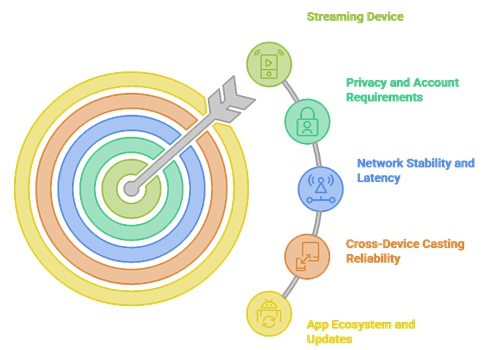
Here is what guided our selection:
- Performance and Codec Support: We chose devices based on responsive playback and support for 4K HDR, Dolby formats, and AV1, so streams look their best without stutter.
- App Ecosystem and Updates: Our team shortlisted platforms with the apps people actually use, frequent security patches, and a track record of long-term support.
- Cross-Device Casting Reliability: We made sure each alternative can cast or mirror smoothly from Android, iOS, Windows, and macOS, so no one is locked out.
- Network Stability and Latency: The experts on our team weighed Wi-Fi 6 performance, Ethernet options, and how quickly each device reconnects after a drop.
- Privacy and Account Requirements: We favored devices that avoid excessive tracking, keep logins simple, and offer clear household profile controls.
Together, these checks helped us narrow a crowded market down to alternatives that stay fast, secure, and reliable over time.
Streaming Sticks vs Streaming Boxes: What’s the Difference?
When you start comparing Chromecast alternatives, you will quickly run into two formats: streaming sticks and streaming boxes. They run the same apps and often share the same software, but the hardware around them is different. Over the years, I have used both, and the right pick really comes down to your TV setup and how demanding you are about performance.
Here is how the two formats compare:
- Form Factor: A stick is a compact dongle that plugs straight into an HDMI port and hides behind the TV. A box is larger and sits on your media stand, so it needs a bit of space.
- Power Source: Many sticks draw power from the TV’s USB port or a small adapter, while boxes almost always plug into the wall. This makes sticks tidier for wall-mounted screens.
- Performance: Boxes typically pack faster processors, more memory, and extra storage. That means snappier menus, fewer app-loading delays, and more room for installed apps.
- Ports and Connectivity: Boxes usually add an Ethernet port and USB inputs, which help with high-bitrate 4K, local media, and stable wired streaming. Sticks mostly rely on Wi-Fi alone.
- Best Use Case: A stick is ideal for budget setups, travel, and simple streaming. A box suits power users who want Plex, gaming, or rock-solid 4K performance.
The line between the two keeps blurring, since many sticks now handle 4K HDR with ease. For most viewers, a 4K stick is enough, but a box is worth it if you want extra headroom.
Do Chromecast Alternatives Still Support Casting?
One of the biggest worries when leaving Chromecast behind is whether you can still send video from your phone to the TV. The good news is that casting is alive and well on most alternatives. The catch is that not every device uses the same method, so it helps to match the casting technology to the phone or laptop you already own.
Here is how casting works across the main alternatives:
- Google Cast Built-In: Google TV and Android TV devices, such as the Google TV Streamer, NVIDIA Shield, Xiaomi TV Box, and TiVo Stream, include Chromecast built-in. Casting from Android and Chrome works much like the old dongle.
- Apple AirPlay: Apple TV uses AirPlay, which makes mirroring from an iPhone, iPad, or Mac smooth and reliable. Many newer Roku and smart TV models support AirPlay too.
- Miracast Mirroring: Fire TV and several Roku models support Miracast, which mirrors many Android and Windows screens without needing the same app on both ends.
- App-Based Casting: Roku does not support native Google Cast, but apps like YouTube and Netflix can still send content to it through their own casting features.
- Same Network Rule: Whatever the method, casting almost always needs your phone and streaming device on the same Wi-Fi network for a stable connection.
So casting has not disappeared. You just need to confirm your device supports the protocol your phone uses before you buy.
How to Set Up Your New Streaming Device?
Setting up a Chromecast alternative is usually quick, and most devices walk you through it on screen. As someone who has set up dozens of these, I find the process is nearly identical across Roku, Fire TV, Google TV, and Apple TV. A little preparation makes it go even faster.
Here is how to get your new device running:
- Connect the Hardware: Plug the device into a free HDMI port, then attach power using the wall adapter or your TV’s USB port. Switch your TV to that HDMI input.
- Join Your Network: Connect to Wi-Fi, or plug in Ethernet if your device supports it and your router is nearby. A wired link helps with stable 4K streaming.
- Sign In to Your Account: Log into the platform account, such as Google, Amazon, Roku, or Apple. This syncs your apps and preferences across devices.
- Install and Update Apps: Add the streaming apps you use, sign in to each, and let the system download any pending firmware updates before you start watching.
- Pair the Remote and CEC: Set up the voice remote and enable HDMI-CEC so a single remote can control TV power and volume. I always test voice search at this stage.
Once that is done, restart the device if streams do not appear right away, and you are ready to watch.
Verdict:
I have tested plenty of streaming sticks and boxes, and the Chromecast space has real competition in 2026. If you are deciding what to buy for speed, apps, and long-term reliability, this verdict should help. I focused on setup, remote control feel, Wi-Fi stability, and day-to-day streaming performance.
- Google TV Streamer 4K: The superior choice for most people, because it feels the most like a polished Chromecast replacement, with smooth Google TV navigation, clean recommendations, and solid smart home integration. It is my top pick for a comprehensive, modern interface.
- Amazon Fire TV Stick 4K Max: A powerful, cost-effective pick for households deep in Amazon services, delivering fast app loading and great Wi-Fi performance. Its feature-rich platform shines for Prime Video and Alexa homes, though the home screen can feel busy.
- Roku Streaming Stick 4K: A top-rated, dependable alternative for anyone who values simplicity and reliability, with a user-friendly interface and excellent app coverage. It is ideal for plug-and-play streaming, though advanced power users may want more controls.
FAQs
Why did Google discontinue the Chromecast?
Google phased out classic Chromecast models to simplify its lineup and push newer Google TV devices that bundle casting, a remote, and a full app-based interface. Chromecast technology itself is not gone, since Cast is built into many TVs and streamers. Older Chromecasts still work, but long-term updates, stock, and support are typically reduced.
Do I still need a streaming device if I already have a smart TV?
Not always, but a dedicated streamer can be a major upgrade. Many smart TV systems get slow over time, have fewer apps, or stop receiving updates. Streaming devices often deliver faster performance, better Wi-Fi, longer software support, and consistent app availability across TVs, plus easier casting and voice control.
Which Chromecast alternative is best for Apple users?
For Apple users, Apple TV 4K is usually the best Chromecast alternative. It supports AirPlay, Apple HomeKit, iCloud Photos, Fitness+, and tight iPhone integration. You also get a fast interface, strong long-term updates, and excellent video quality such as 4K HDR, Dolby Vision, and Dolby Atmos when your TV supports it.
Do these streaming devices work with any TV?
Most Chromecast alternatives work with nearly any TV that has an HDMI port. Plug the device into HDMI, connect power, then set the TV to that input. For the best results, use a TV with HDCP-compliant HDMI and stable Wi-Fi. Older TVs without HDMI will require an HDMI-to-AV adapter, with reduced quality.
Can I still cast from my phone without a Chromecast?
Yes. You can cast without a Chromecast if your TV or streaming device supports Google Cast (often labeled Chromecast built-in), AirPlay, or Miracast. Many Roku, Android, and Google TV devices, along with smart TVs, offer casting features. You can also cast within specific apps to supported devices, or use screen mirroring from Android or iPhone.