
Key Takeaway: Stremio is legal software and the official app is generally safe when downloaded from Stremio. Your real risk depends on the addon, the rights behind the selected stream, and whether playback uses a licensed service, an unknown web host, BitTorrent, or a debrid cache. Neither a VPN nor debrid converts an unauthorized stream into a licensed one.
Stremio can look completely legitimate on one screen and legally questionable on the next. The same app may point you to a paid service, play your own file, retrieve a public-domain film, or offer a torrent uploaded without the copyright owner’s permission. That is why a simple yes or no answer is not useful.
I reviewed Stremio’s current terms, privacy policy, addon documentation, source architecture, copyright guidance, and the leading explanations published in 2026. This guide separates four questions people often mix together: whether the software is lawful, whether a particular stream is authorized, whether your device is secure, and who can observe the connection.
Is Stremio Legal? The Short Answer
Yes, Stremio is a lawful media platform. Its terms describe it as a metadata catalogue and platform for official audio and video content. Installing it, organizing a library, playing personal files, or opening authorized services is not piracy. The legal question begins only after you select a source and depends on the rights attached to that particular stream.
- Legal Software: A media player and addon protocol have substantial lawful uses, just like a browser, torrent client, Kodi installation, or personal media server.
- Source Matters: A title appearing in Stremio proves only that metadata exists; it does not prove every playback option beside it is licensed.
- Permission Controls: Streams are safest legally when the copyright owner, licensed distributor, public-domain status, or an open license clearly authorizes access.
- Technology Is Neutral: HTTP, BitTorrent, and cloud caching can distribute lawful material, although the same technologies can also deliver unauthorized copyrighted works.
- Local Law Applies: Stremio requires users to comply with relevant legislation, while its terms assign community developers responsibility for the content they provide.
The Fastest Way to Judge a Stremio Stream
Do not judge a result by the addon name, resolution, file size, or the fact that it plays inside Stremio. Instead, identify the source and ask who authorized it. I use the following decision table because it turns a vague legal warning into a check you can perform before pressing play.
| Source | Legal position | Privacy issue | Verify |
|---|---|---|---|
| Licensed service | Usually legal with valid access | Provider tracking | Domain, subscription, and region |
| Authorized or public-domain stream | Legal when the rights claim is genuine | Host receives your connection | Rights statement and publisher |
| Your local media | Usually legal when lawfully created or owned | Local sharing settings | Ownership and copy restrictions |
| Unknown HTTP stream | Unclear until rights are confirmed | Host sees your IP and request | Operator, license, policy, and HTTPS |
| Public torrent | Depends on the work and authorization | Peers can see your public IP | Uploader, license, and rights holder |
| Debrid-cached result | Caching does not grant a license | Provider can associate account requests | Authorization, policy, and labels |
- Paid Elsewhere: A new film, premium series, or pay-per-view event offered free by an unknown source deserves immediate skepticism about authorization.
- Visible Publisher: Favor sources where a studio, broadcaster, creator, library, university, or open-source project clearly identifies itself and explains distribution rights.
- License Evidence: Look for a public-domain statement, Creative Commons terms, paid entitlement, or a direct connection to the authorized streaming provider.
- Result Labels: Learn whether the entry is a subscription redirect, direct web stream, peer-to-peer torrent, or cached debrid file before playback begins.
- Unclear Means Stop: If neither the addon nor host explains where a commercial title came from, do not assume availability equals permission.
Stremio, Addons, and Streams Are Three Different Trust Layers
Many competitor guides treat “Stremio” as one product, but the app, addon, and stream can be operated by three different parties. Stremio supplies the interface and protocol. An independent developer may run the addon server, while a separate host or peer supplies the video. Each layer has its own legal, privacy, and reliability questions.
- Application Layer: Official Stremio software manages your interface, account sync, library, player, and requests sent to the addons you have installed.
- Addon Layer: The addon returns metadata or stream links; Stremio says community addons are independently developed and not controlled by its support team.
- Content Layer: The actual video may come from a licensed service, public website, cloud cache, personal server, or peers in a torrent swarm.
- Account Layer: External configurators can request debrid tokens, IPTV credentials, or Stremio authentication, creating risks that do not originate in the player.
- Decision Layer: You choose the result, so check the source label instead of assuming Stremio or the addon has cleared every title.
Are Official and Community Addons Equally Safe?
No. Official addons are maintained within Stremio’s ecosystem, while community addons are remote services built by third parties. Stremio’s addon documentation explains that installing one does not install additional software locally; the app uses the remote service to search for content. That architecture lowers malware risk but does not establish licensing, privacy, or honest operation.
- Official Addons: These provide core functions or connections maintained by Stremio and generally offer the clearest operator identity and lowest uncertainty.
- Community Addons: Independent developers control their servers, data handling, source selection, maintenance schedule, and any configuration page outside the app.
- No Local Plugin: A standard hosted addon cannot silently install an executable on your device, unlike a modified APK, desktop program, or browser extension.
- Remote Risk Remains: A hostile service can log requests, redirect users, mishandle tokens, change returned links, disappear, or later transfer to another operator.
- Trust Must Expire: An addon that was reputable last year still deserves review when its repository is archived, domain changes, or maintainer becomes inactive.
What Changes When Stremio Uses BitTorrent?
BitTorrent is a lawful file-transfer protocol, but it works differently from ordinary streaming. Your device normally exchanges pieces with multiple peers rather than receiving one private video connection. If the work is unauthorized, this can implicate copying and distribution concerns, while your public IP address becomes visible to other participants and monitoring organizations.
| Playback path | Who receives your IP | Peer upload | Proof of legality? |
|---|---|---|---|
| Licensed HTTPS | Service and ISP | No | Strong evidence from an authorized provider |
| Unknown HTTPS | Host and ISP | No | No; the host may lack rights |
| Raw BitTorrent | Peers and ISP | Usually | No; verify work and uploader |
| Debrid-cached HTTPS | Debrid provider and ISP | Not to the public swarm | No; delivery is not permission |
| VPN plus BitTorrent | Peers see VPN address | Usually through tunnel | No; privacy creates no license |
- Public Swarm: Peers need addresses to exchange pieces, so a torrent connection is not private merely because playback looks like conventional streaming.
- Upload Behavior: Receiving and sharing pieces can happen together, which is legally important in countries that treat distribution more seriously than private viewing.
- Lawful Torrents: Linux distributions, creator-authorized media, open-source software, and public-domain works show why the protocol itself cannot be labelled illegal.
- Copyrighted Torrents: The US Copyright Office states that unauthorized uploading or downloading through peer-to-peer networks may infringe reproduction or distribution rights.
- Cache Settings: Stremio may store playback data temporarily or on disk, but changing cache size does not change the underlying authorization.
Does Real-Debrid Make Stremio Legal?
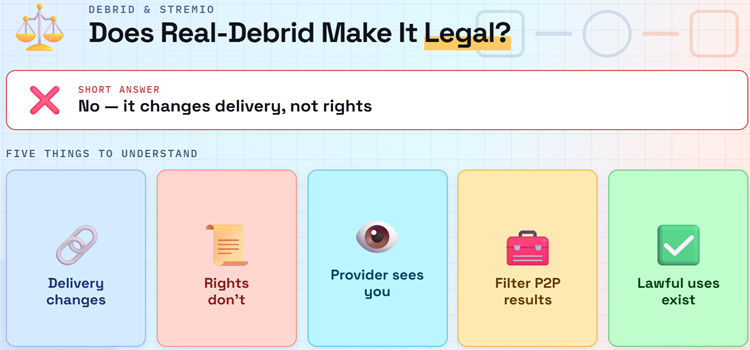
No. A debrid service can retrieve or cache a file on its own infrastructure and provide an HTTPS link to you. This may improve speed and prevent your device from joining the public torrent swarm, but the service does not automatically own film or television rights. Authorization still depends on the work and its source.
- Delivery Changes: Your device usually connects to the debrid provider rather than exchanging pieces directly with public peers when a cached result is selected.
- Rights Do Not: A faster private link cannot transform an unauthorized copy into licensed content or give you permission from the copyright owner.
- Provider Visibility: The debrid company can receive account information, IP addresses, request records, and payment details according to its own policy and legal obligations.
- Result Filtering: Configure addons to exclude uncached or P2P results if you intend to avoid accidentally joining a torrent swarm through another option.
- Legitimate Uses: Debrid services can accelerate lawful downloads, open-source files, personal archives, and content whose distribution license permits that retrieval method.
Can a Stremio Addon Give Your Device Malware?
A normal hosted Stremio addon is closer to a web service than a locally executed plugin, so it cannot install programs in the same way as an untrusted APK. That is a meaningful protection, not an absolute safety guarantee. Fake installers, deceptive configuration pages, exposed tokens, hostile redirects, and outdated clients remain realistic risks.
- Use Official Builds: Download only from the current Stremio downloads page or a store it links, never an unrelated APK mirror or sponsored search advertisement.
- Inspect Configurators: Avoid pages demanding your Stremio password, payment details, shell commands, security disabling, or more credentials than the advertised function requires.
- Protect API Tokens: A debrid token can allow account use and expose request history, so revoke it immediately after accidental disclosure.
- Update the Client: Open-source projects still receive security reports; current releases reduce exposure to bugs already identified and corrected by maintainers.
- Remove Abandoned Addons: Uninstall services whose domain changed unexpectedly, repository disappeared, manifest fails repeatedly, or maintainer no longer communicates with users.
What Does Stremio Know About You?
Stremio’s privacy policy says it does not collect history or logs of which addons or sources you use. Registered accounts still provide an email address and generate technical log information, while Guest Mode avoids personal account data. Separate addon, streaming, debrid, Trakt, subtitle, and identity providers have their own visibility.
- Stremio Account: Registration supports account recovery and synchronization, while the provider says passwords are stored in a cryptographically hashed form.
- Guest Mode: This reduces personal data shared with Stremio’s backend but sacrifices cross-device library, settings, and addon synchronization features overall.
- Addon Requests: A remote addon must receive enough information to answer your catalog, metadata, subtitle, or stream query, revealing interest in requested titles.
- Playback Provider: The selected host, peer network, debrid service, or subscription platform sees connection information needed to deliver the video.
- Linked Services: Trakt, external players, subtitle services, social logins, and other integrations follow their own privacy policies and retention practices.
Do You Need a VPN With Stremio?
Not for Stremio itself. A VPN is a privacy and network-security tool, not a copyright permission service. It can hide destination details from your ISP, replace your visible address in a torrent swarm, and protect traffic on untrusted Wi-Fi. It cannot validate an addon, remove malware, or make an unauthorized stream lawful.
- Useful Cases: Consider a trustworthy VPN for public Wi-Fi, raw P2P, ISP privacy, or ordinary secure remote use where local rules allow it.
- ISP View: Your provider generally sees an encrypted VPN connection instead of individual destinations, although the VPN operator becomes another party you must trust.
- Peer View: Torrent peers normally see the VPN server’s address rather than your home address when the tunnel and kill switch work correctly.
- No Legal Shield: Stremio itself warns that community addons may use torrents and users should confirm legality in their country before using those sources.
- No Absolute Anonymity: Accounts, payments, cookies, addon logs, device compromise, DNS leaks, or VPN records can still connect activity to a person.
How Copyright Risk Changes by Country
There is no universal “Stremio law.” Countries apply copyright rules to the act, content, knowledge, and evidence rather than to the purple app icon. The comparison below is a starting point, not a substitute for local advice. It deliberately avoids claiming that every private viewer faces the same civil or criminal consequences.
| Region | Reliable baseline | Why it matters |
|---|---|---|
| United States | Unauthorized P2P may infringe reproduction or distribution rights | P2P can receive and share pieces |
| United Kingdom | Guidance covers unauthorized apps, addons, and sources | Streaming alone does not prove permission |
| European Union | Clearly unlawful streams may fall outside the temporary-copy exception | Temporary storage is no blanket defense |
| Other countries | Exceptions, penalties, and enforcement vary | Check current local law |
- US Baseline: Copyright owners control reproduction and distribution, but individual streaming disputes depend on facts and should not be reduced to a universal penalty claim.
- UK Warning: UK government guidance expressly includes unauthorized apps and addons when describing illegal access to protected films, television, sports, or other content.
- EU Decision: The CJEU’s Filmspeler judgment rejected a temporary-copy exemption for protected works obtained from a knowingly unauthorized streaming website.
- Enforcement Differs: Site blocking, warning letters, civil claims, account action, and criminal prosecution target different actors at different thresholds across jurisdictions.
- Facts Win: The same addon can return a lawful public-domain file and an unauthorized commercial release, so legality must be assessed per result.
A Safer, Legal Stremio Setup Plan
You do not need to abandon Stremio to remove most uncertainty. Start with the official client, keep only transparent addons, and choose sources whose rights you can explain in one sentence. For a deeper device-security audit, use our complete Stremio safety guide after completing the legal checks below.
- Install Officially: Match your operating system and processor on Stremio’s own download page, then keep automatic or store updates enabled whenever possible.
- Prefer Clear Rights: Use licensed subscription links, public-domain libraries, creator-authorized releases, open licenses, and personal media you already lawfully control.
- Audit Addons: Check developer identity, repository activity, domain history, privacy explanation, requested credentials, manifest status, and recent independent user reports.
- Read Source Labels: Separate official, direct HTTP, torrent, cached, and subscription results instead of selecting the first 4K file automatically.
- Review Regularly: Remove unused addons, revoke old tokens, use unique passwords, update the app, and investigate any unexpected domain or configuration change.
Final Verdict: Is Stremio Legal and Safe?
Stremio is legal and its official software is reasonably safe, but that verdict does not automatically extend to every community addon or result. The decisive question is not “Did Stremio show it?” but “Who is authorized to distribute this exact stream, and what network path will my device use?”
- App Verdict: Legal media software with open-source components, official downloads, account controls, and an addon design that avoids installing ordinary plugins locally.
- Addon Verdict: Official options carry lower uncertainty; community services require independent checks because operators, sources, data practices, and maintenance vary significantly.
- Content Verdict: Licensed, public-domain, openly licensed, and personal media are lawful routes; unauthorized copyrighted streams can create real legal exposure.
- Privacy Verdict: Raw torrents expose an address to peers, debrid shifts trust to a provider, and a VPN changes visibility without granting rights.
- Practical Verdict: If you cannot identify the operator, authorization, and source type, choose a clearly licensed option rather than treating uncertainty as permission.
FAQs
Can you get in trouble just for installing Stremio?
Installing the official Stremio application is not the problem. Legal risk relates to what a user or addon developer accesses, copies, shares, or distributes. A clean installation used for licensed services, public-domain media, authorized torrents, metadata, subtitles, or your own lawful files has legitimate purposes.
Is Torrentio illegal to use?
A source-finding addon is not automatically illegal, and torrents can carry lawful works. The risk depends on the specific result. Selecting an unauthorized copy of a copyrighted movie or show may infringe local law, while streaming an open-license or public-domain torrent can be lawful.
Does a VPN make Stremio legal?
No. A VPN encrypts traffic and changes which IP address destinations or peers observe. It does not obtain permission from a studio, broadcaster, creator, or distributor. Use it for legitimate privacy and network-security reasons, then make a separate decision about the content’s authorization.
Is Stremio safe without Real-Debrid?
Yes, if you use authorized direct streams, official subscription links, public-domain media, metadata, subtitles, or personal files. Real-Debrid is not required for the app’s safety. It changes how compatible files are delivered, but it neither validates addons nor makes unauthorized content legal.
Are Stremio community addons viruses?
Standard hosted addons do not install executable plugin code on your device, so their malware risk is lower than an untrusted APK. Still, community configurators or linked sites can phish for credentials, log requests, mishandle tokens, redirect traffic, or change ownership. Review each operator before use.
Which Stremio addons are legal?
Look for addons serving metadata, subtitles, authorized broadcasts, open-license material, public-domain works, or links to subscriptions you legitimately hold. Our current Stremio addon guide can help you compare functions, but always verify the rights behind the individual stream you select.
Does Stremio track everything you watch?
Stremio says it does not collect history or logs of the addons and sources you use. Registered accounts and technical operation still involve some data, while each addon and playback provider sees information required to answer a request. Guest Mode reduces account data but removes synchronization.